The Siddapura-Honnavara highway is one of the least crowded highways in the country, but it cuts directly through the heart of paradise.
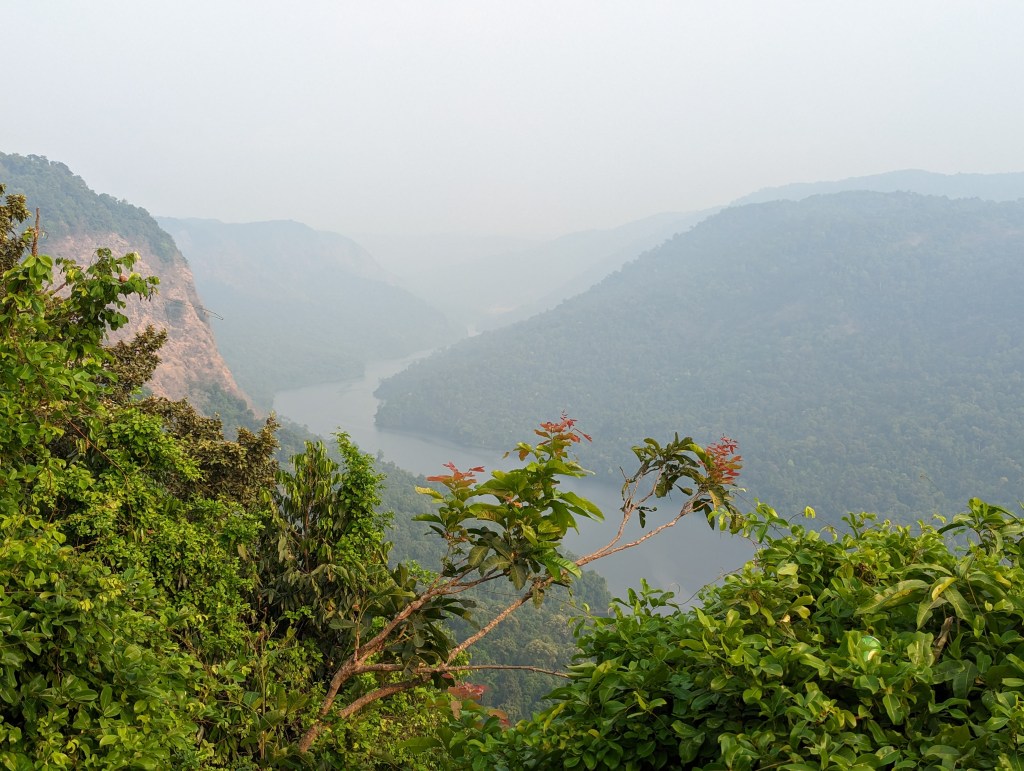
The beating heart of Uttara Kannada, the Sharavathi River, flows along its undulating path alongside the highway, kilometres below the concrete in its gorge. Along this river valley grow thousands of trees, forming a dense wet evergreen forest patch that teems with life. From the elusive lion-tailed macaque that rarely leaves the high canopy to the watchful jungle cat that prowls along the understory, from the hornbills that cackle wildly to the tiny pipits that hop along the forest floor, the forests of the Sharavathi River Valley are a veritable museum of life in the Western Ghats.
Different species have adaptations to survive a range of conditions, and some wildlife in the Sharavathi is adapted to life in the rarest ecosystem of them all – the Myristica swamp. Named for its dominant tree family – Myristicaceae (wild nutmeg) – this is a unique type of swamp with towering trees that date back to the formation of the Western Ghats and have developed arching roots to survive in a waterlogged environment year-round. Uttara Kannada is home to over 100 swamps, but while they were once connected along waterways like the Sharavathi, today’s swamps only exist in isolated patches, fading into oblivion quietly amidst the chaos of development.
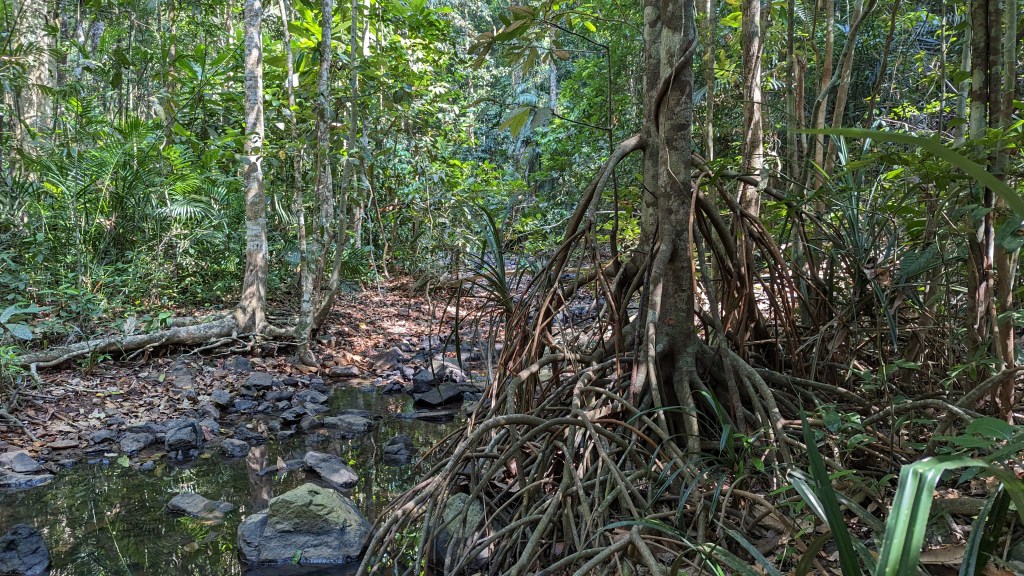
Kathalekan is one such swamp. Located right alongside the Siddapura-Honnavar highway, it somehow straddles the human-wild interface without too much apparent grief. But signs of human interference emerge as you enter this dark forest. Empty beer bottles and plastic chip packets litter the floor. A plastic bag, snared on a forked branch, waves like a flag. Tiny packets of Vimal and cigarette butts float in the freshwater, a stark reminder that even the most precious resource – water – is revered in parts and equally ignored in others.
Of course, biodiversity finds a way despite the human interference. Arching stilt roots erupt wherever you look, taking one back to the time of the dinosaurs, when forests towered into the sky, barely letting the sunlight through, and the sound of thousands of tiny critters created a background track for the landscape. Tiny green and red odonates – stream glories and stream rubies – flit from rock to rock, their iridescent wings capturing and manipulating the sunlight as it filters through the dense foliage. I hear the crik-crik-crik of the dancing frog, Micrixalus sp., and we keep our eyes peeled for the rare Malabar tree frog. Myristica swamps like Kathalekan are hothouses for amphibians and reptiles, and the allure of the Malabar pit viper is what keeps our eyes peeled as we stumble through the cool water. Vipers tend to lie still near the main stream, waiting for unsuspecting prey to approach. They are ambush predators, you see. Tiny night frogs (Nyctibatrachus sp.) leap out of our way, so small that their movements could be mistaken for those of crickets. Rustling leaves has me spinning on my heels; king cobras are known to lay their eggs in enormous leaf-covered nests on the sloping banks leading down to the stream, and I am definitely not ready to become lunch! Luckily (or unluckily), it is only a skink, hastily beating a retreat from our clomping feet. I’m just relieved to not step on a hump-nosed pit viper, another camouflaged reptile that most often lies in dense leaf litter, utterly hidden from view until provoked or stepped on.

Kathalekan is also a hotspot for the rarest monkey of the Western Ghats – the lion-tailed macaque (LTM), or singalika (in Kannada). This macaque has been highly impacted by the rise of linear intrusions such as roads and highways in the larger landscape of Uttara Kannada. Mostly arboreal, the LTM prefers to remain high in the canopy, feeding on jackfruit and fishtail palm, as well as on the fruits of the Myristica trees. They frequently visit Kathalekan and its associated swamps as part of their daily foraging patterns and play a key role in seed dispersal for the Myristica trees. How do they do this? Well, these macaques – much like hornbills and other frugivorous (fruit-eating) birds in these forests – eat the fleshy red seed coat (known as an aril) that surrounds the seed, freeing it and dropping (or pooping) it onto the forest soi. In the case of Myristica, crabs snatch up these fallen seeds and bury them near the water, which allows the seeds to germinate and grow, keeping the circle of life intact and well.
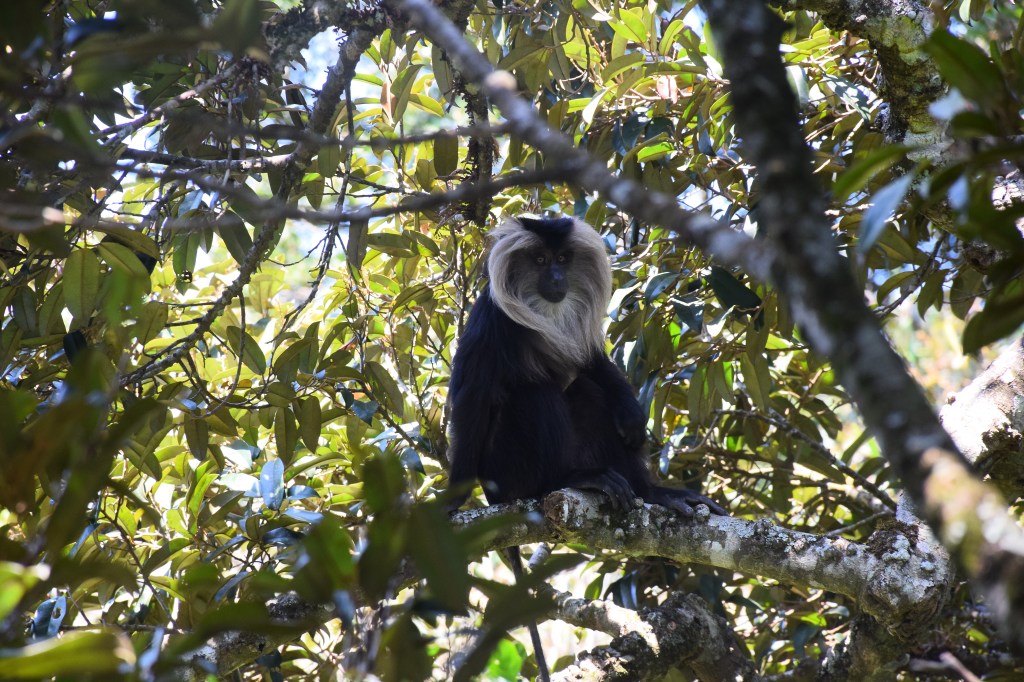
As we step out of Kathalekan, the reality check is intense. A car whizzes by on the highway, honking vigorously as it rounds the bend. The trees stand stalwart, their crowns so high that the leaves barely flutter in the tailwind of the vehicle. The shrieking cry of a hornbill echoes through the Sharavathi valley far below. The leaves rustle as a grey langur bounds up to safer grounds; a green imperial pigeon hoots mournfully as the peace of the forest is momentarily disturbed. With a road nearby, these forest residents are well-versed in human activity, but it hinders their daily activities too. The forest department has created rope bridges connecting the trees on either side of the highway at various places, hoping that LTMs and other arboreal life will use these crossways instead of attempting to cross the road. Hopefully this will reduce roadkill incidences in this biodiversity hotspot.
Kathalekan – the dark forest – stands tall and stalwart in a landscape of extreme change. From highways to dams, the modifications to the natural landscape in Uttara Kannada are ever increasing, and as I stand at the entrance to this ancient swamp, I wonder if the dark forest will soon succumb to the light.
 On Life and Wildlife
Excellent information and wonderful narration. Thanks a lot.
LikeLike