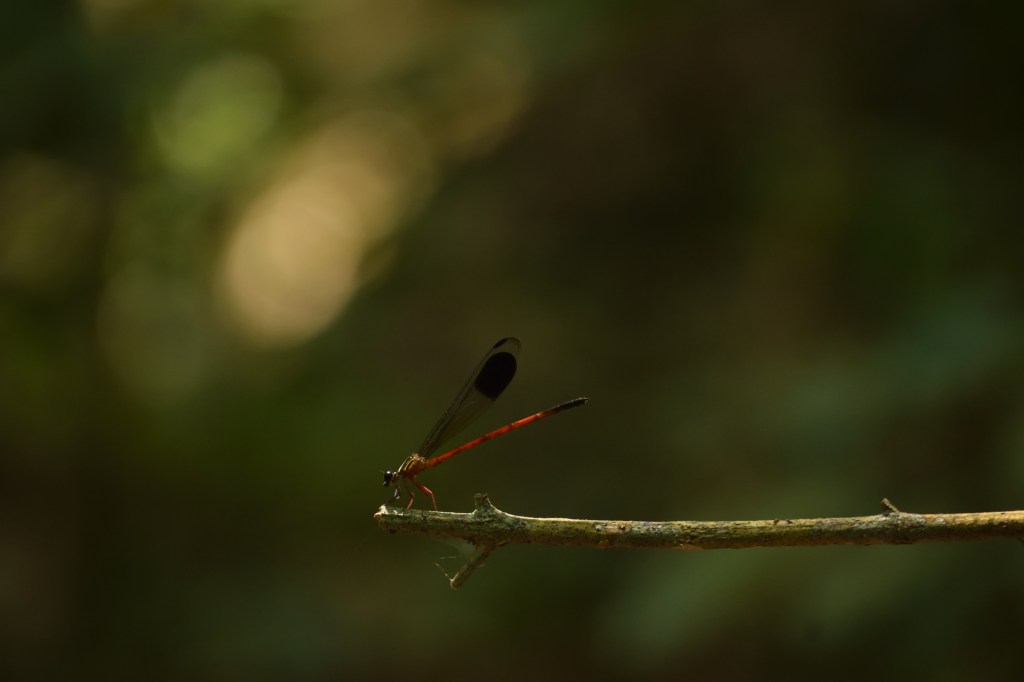
Dry leaves crunch beneath my sandals as I swerve to narrowly avoid the prickly bladed fronds of Pinanga dicksonii, a plant that frequently impedes my expeditions into Myristica swamps. A spine snags my shift regardless, nipping my skin through the woven material, and I yelp irritably. The loud ‘trrrrrick’ of the Indian bullfrog echoes through the dense forest, and a damselfly – a Malabar torrent dart – hovers busily in a patch of dappled sunlight. It barely moves, levitating in its chosen spot, as I edge close enough to snap a photograph – beautiful! What a pose! The damselfly bobs aside as I continue down the path, ducking here, weaving there, nearly slipping on the layered leaf litter that my sandals cannot quite get a grip on.
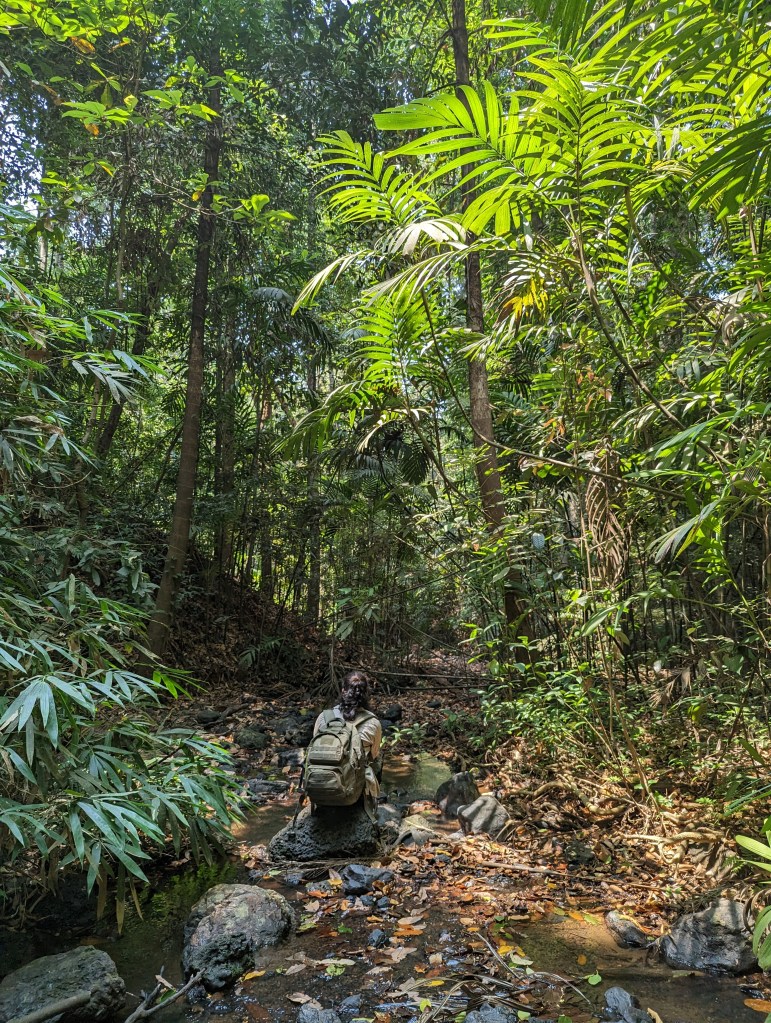
The swamp beckons me, the air cooling further as I approach the gently-gurgling water. I can hear the gentle rustling of leaves and the slight sucking sound as the water laps the arching stilt roots of the Myristica fatua trees, mud slopping against the knee roots of the occasional Gymnacranthera canarica. A reddish-hued crab scuttles sideways, disappearing into a perfectly-round hole in the soft mud. A brilliant blue kingfisher gives me a disapproving glare before going back to observing the rippling water. Two large Malabar Tree Nymphs – white butteflies with black spots – drift high above the water in the evergreen canopy, unhurried and feathery-light. The swamp seems to sigh as I set foot in the cool water. At last, I am back.
An echoing quavering hooting cry steals my attention away from the stilt roots of my favourite tree. It sounds just like a grey langur, but as I focus, the call is longer, softer, more haunting in tune. While langurs do hoot, they certainly don’t capture one’s imagination as much as this call does mine.
A green imperial pigeon. These stout birds are (as perhaps expected when you hear their name) an metallic green colour and are found in the deep forests of southern India, Nepal, Sri Lanka, and parts of Southeast Asia. With a white underbelly, they strut rather pompously around the dense forest understory, startling easily at the slightest sound and fluttering to the highest branches. These pigeons feed on the aril (fleshy seed coat) of multiple species of trees and are a staple resident of Myristica swamps. Not that the swamps hold a special appeal to this bird; wet evergreen forests provide adequate food resources and nesting habitat that this colourful pigeon requires to survive.

A fluttering of wings breaks my reverie and two green imperial pigeons land on the arching stilt roots of the Myristica tree across the stream. One delicately pecks among the roots while the other trains a beady black eye on me, watchful but not afraid. And then, when a frog leaps into the water, they take flight once more, their quavering hooting calls echoing in their wake.
 On Life and Wildlife