The waters are silvery-gold, shimmering lightly in the morning sunlight. The fisherfolk are already hard at work; their days begin at the crack of dawn. Nets whirl elegantly, fanning out in a circle. There are no women in sight; fishing in Odisha appears to be a male-dominated task. The men are busy fixing torn nets and tying together stacks of bamboo sticks that will be used as fish traps. There are three types of bamboo fish traps used here, and I keep my eyes peeled for all three as we make our way through the chaos to our boats.

The fishing boats are long and slender with curved ends like fancy juttis. Each boat is steered by two men – one manning the motor and the other using a long bamboo pole. The pole comes in handy in shallow waters where dense mats of floating vegetation can tangle in the motor.
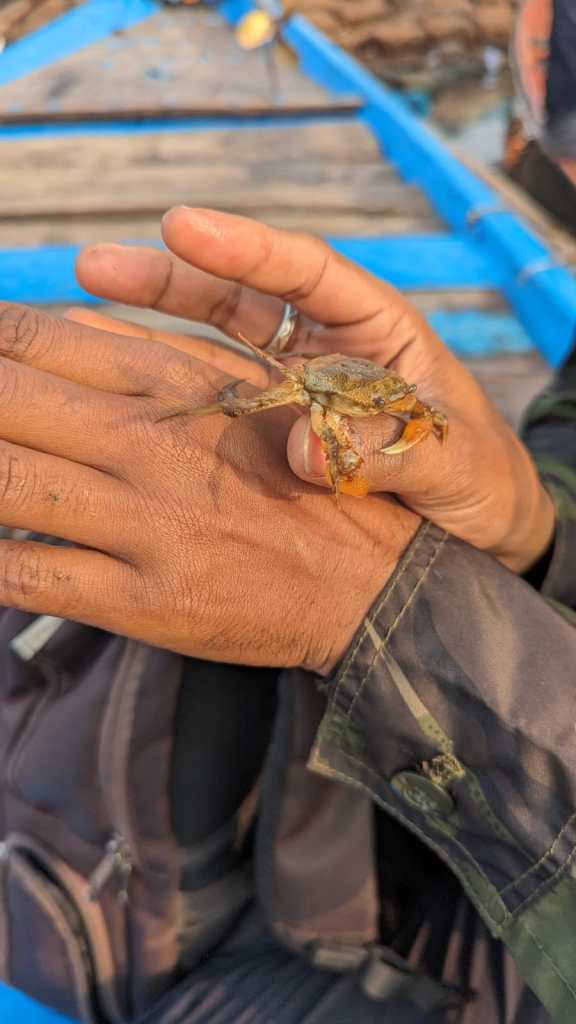
Our boat is rife with crabs and as we try to drop them into the water, they pinch us angrily. Ravi yelps as one clings stubbornly to his finger. Sovit and Utkarsh keep their legs well above the crab-invested base of the boat, and Ragul stands on the prow like a masthead. Sangita di calmly sits and watches the sun-kissed waters. Beside our boat, the other two boats filled with our batchmates pitch and heave as people find their seats and explore the delights of fishing boats. We also – to my delight – have a pantry boat, equipped with a gas cylinder and large vessels. They are already hard at work boiling eggs and preparing coffee for us to sip while out on the lake.
We push off from the shore after learning how to use the water quality equipment. Each boat has a mix of instructors and students and each has a specific set of tasks. The day’s plan: to traverse Chilika from her freshwater zone to the saline intertidal zone and learn about the macrophytes, macroinvertebrates, fish, birds, and water quality as the lake shifts between zones. As we putter away from the dock, our cheerful voices mingle with the shouts of the boatmen and the lonely lowing of a cow.

Our boat is a bit chaotic, with lots of side-to-side tilting and many screams accompanying each tilt. Jagdish Sir discovers the minefield of crabs a few minutes after the rest of us and scolds us for dumping them overboard. “After all, they aren’t deep water creatures,” he says firmly. “We should let them remain in the boat and drop them off on the shore when we return.” Chastised, we let the crabs scuttle to freedom under the tarpaulin laid down on the floor of the boat.
Nearly every pole, post or half-submerged tree is peppered in blue-tailed beeeaters. A pied kingfisher flutters its wings rapidly as it hovers high above the water. Faster than the blink of an eye, it dives straight into the water and emerges holding something small and floppy. A fish! Up ahead in the open waters, ducks dot the surface. Crows caw curiously as we punt by. Our brightly painted boats bob along the surface of this Ramsar wetland, the boatman skillfully weaving around docked boats, fishing nets, and head towards the open waters.

Chilika gleams like the scales of a fish as we set off across her waters.
 On Life and Wildlife