
Little silver fish skip across the water’s surface, so light and quick they might as well be flying. Like silver bullets, they cleave the waves effortlessly, skipping like stones.
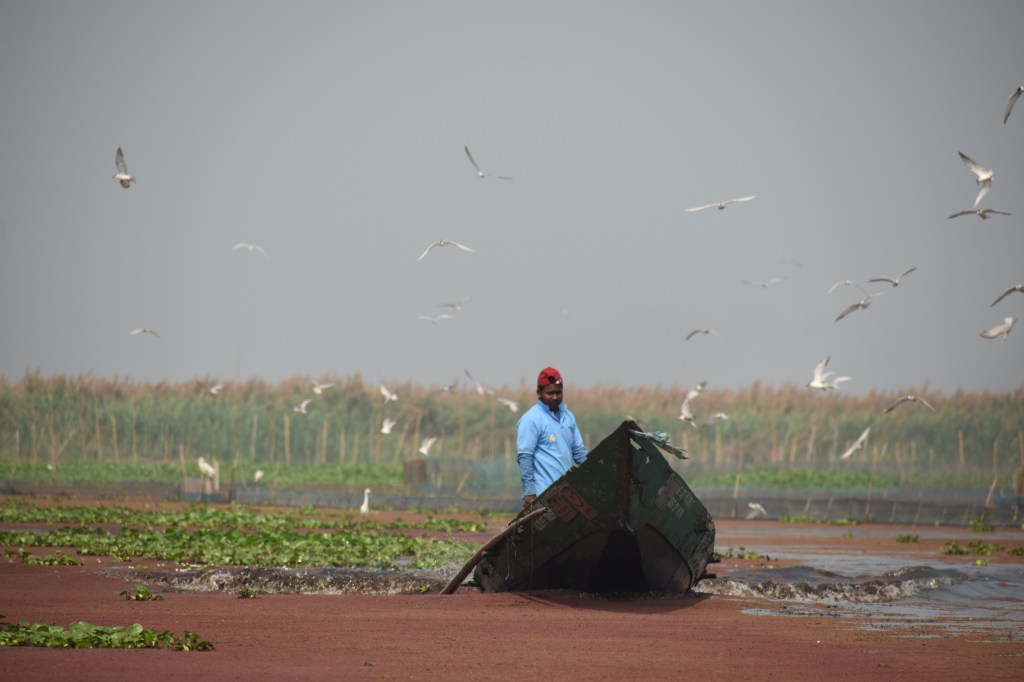
Fishermen spin their nets once, twice, and let them go. The nets flare as they descend. A meal secured. The terns flap noisily around the nets, waiting for leftovers.

The spraints smell strongly of sulphur and are slightly liquidy. Near them lie a smattering of claw marks. Smooth-coated otters were here. Partho da parts the Phragmites and shows us the claw marks leading into the dense wetland vegetation. The otters might be watching us look for them.
When we leave, the otters will slip out once again to play.

The fishing cat is the lifeline of Chilika. Elusive and stealthy, it haunts the Phragmites-dominated marshlands of the lagoon’s northern shores. Here, the Mahanadi dissipates into 52 tributaries that form meandering channels leading to Chilika. Here, the land is shallow and moist. Your feet are sucked into the gluey, grey clay. But the fishing cat balances its weight lightly atop the soil, creeping through the tall reeds and quickly snatching up its unsuspecting prey – fish. It turns, tail whipping, whiskers quivering, and pads back into the cover of the reeds to eat its meal, a trail of ghostly pawprints the only sign of its presence.
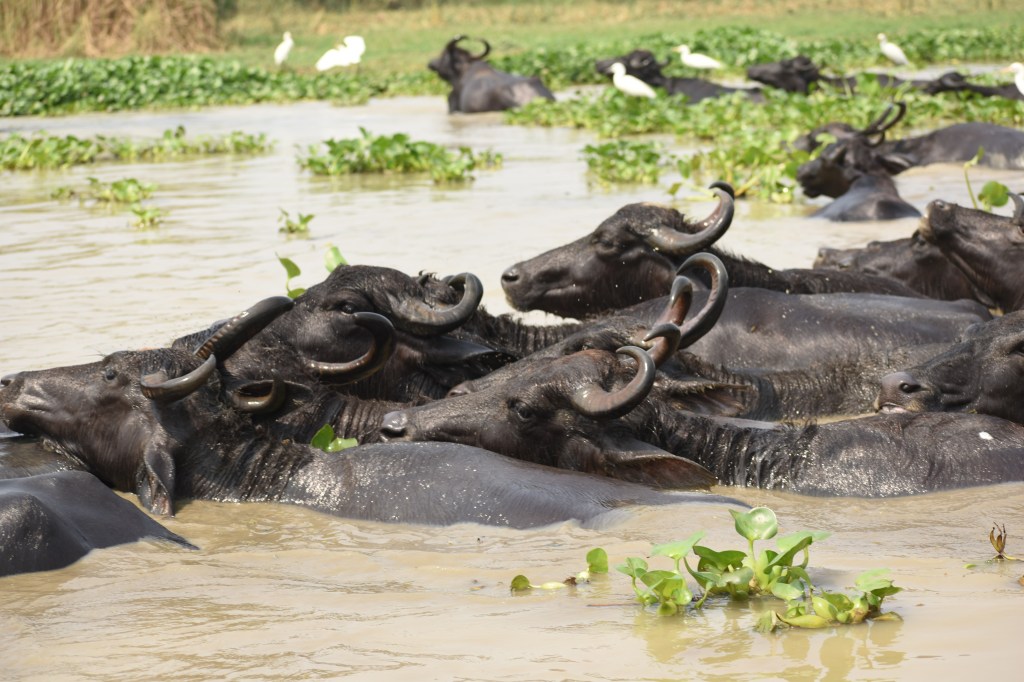
The Chilika buffalo is a large, plodding creature with doleful eyes and huge, turned-up horns. Hundreds of them trudge through the shallow water of Chilika, making their way towards tasty grazing grounds. We first sight these water buffalo at Nalbana Bird Sanctuary, where they make their way across the grass-covered mudflats, cropping up the grass blades. They are least bothered by the cattle egrets that have adopted them and search for insects on the buffaloes’ hairy backs.
We next meet the buffalo at Pee Island. A tiny, isolated island makes for the perfect location for an impromptu bathroom break, thus lending the island its (unfortunate) name. Don’t worry, the Odia people have a different, more respectful name for this landmass. The buffaloes are wandering across the island, feeding on the dense undergrowth. One buffalo lies dead by the lakeshore, and the stench hits me before I spot it. We give it a wide berth and click photos of the masses of ruddy shellducks bobbing on the shallow water. These large reddish ducks are content to pose for photographs, and we click to our hearts’ content.
Our third encounter with the Chilika buffalo is in the freshwater channels of the Mahanadi. There are 52 rivulets that flow into Chilika, all descending from this great river. We traverse one of these rivulets in our trusty fishing boats, the sun beating down on us mercilessly. Suddenly, we see a cluster of white birds – egrets – perched on moving black objects in the channel in front of us. Hundreds of buffalo swim through the water, rolling their eyes in alarm as the boats draw near. Our boatmen skillfully avoid the large buffalo, and we stare at the sight. A chain of swimming buffalo stretches far into the horizon, sending waves bumping gently into our boats. The egrets hang on cheerily; for them, breakfast is served.

Ravi stands up on the boat suddenly. “Dolphins!” he yells, pointing at a white crested wave. We drop whatever we are doing and leap to our feet, the fishing boat swaying precariously as the boatman struggles to balance our weight. Sure enough, we see gleaming grey bodies arcing through the water, just below the surface. A tail appears, perfectly forked, the sunlight drawing it into sharp focus against the blue water of the lagoon. A flock of gulls swarm around the dolphins, occasionally dive-bombing them. Competition for fish, perhaps? The dolphins are poking around the vast maze of fishing nets set up by fisherfolk in the shallow waters around mudflats. In the low tide, the water exposes the mudflats, making these excellent sites for smaller waterbirds to peck about for food. Oysters abound in this part of Chilika.
But the dolphins steal my heart without even trying. They swirl around each other, tails flapping, throwing themselves into the air and landing smoothly in the water. Silvery droplets accompany their journey. These are Irawaddy dolphins, a shy animal. They journey between the Bay of Bengal and the saline waters of Chilika. With rounded heads and a fixed little smile on their faces, these dolphins look friendly and curious, and I click away furiously on my camera, hoping they come towards us.
But like all good things, the dolphins must leave too. They turn towards the open waters, towards the intertidal zone that will lead them out to the Bay of Bengal, and begin their return to the freedom and expanse of the ocean. We stop the boat and watch them fade into the distance, the flock of gulls the only marker of their location as the sun swallows them up.
 On Life and Wildlife