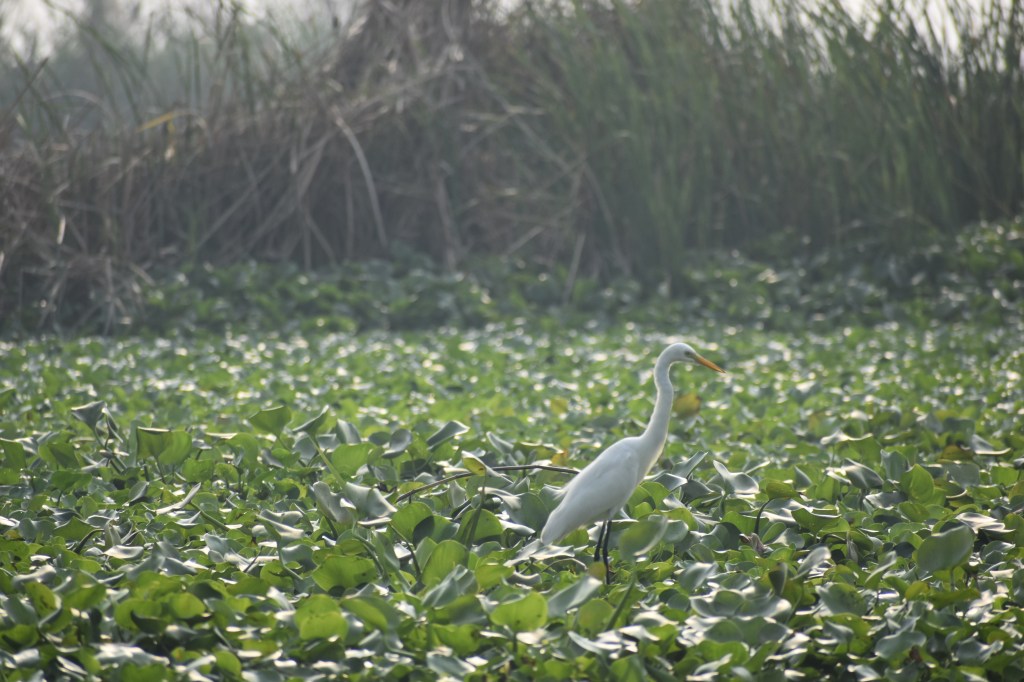
A sea of green broad leaves. Pale purple flowers pop up on occasion. A pond heron stands perfectly still on this mat of greenery. The blue waters are barely visible. Water hyacinth. It grows voraciously, swallowing the river, clogging the channel, and tangling in the boat’s propeller.

Purple swamphens peck about on the wet meadows bordering the channel. The channel’s banks are a forest of Phragmites, towering nearly 10 feet above the water’s surface. Large egrets, openbill storks, purple herons, and pond herons stalk their prey – small fish and aquatic macroinvertebrates – from the safety of the Phragmites. A cormorant spreads its inky wings, the water droplets rolling off its back fluidly. An oily layer helps most waterbirds repel water from their feathers as soon as they come ashore.
Hyacinth blooms often spell death for aquatic life. We measure the dissolved oxygen (DO) to see if our assumption is correct. Here, the DO is 0.80 mg/L, shockingly low for an open water lentic system. The hyacinth uses the DO to spread, preventing oxygen from diffusing into the deeper waters to be used by fish, plankton, and macroinvertebrates.
The Phragmites flank our boat as we putter through this tributary of the Mahanadi. The fishing boat tilts side to side as the boatmen skillfully steer us around the hyacinth. They have to hack at the hyacinth as it tangles around the motor, else the boat will stall.
The birds are active as can be and when we leave the channel and enter the vast waters of Chilika, flocks of terns and gulls take flight, squawking in alarm. Fishing nets are strung between poles, spreading between waterways like lane dividers on a highway. There are floating red inflorescence forming vast mats, interspersed by lily pads and tiny white flowers. Cormorants, storks, egrets, herons – our feathered friends are scattered all across the lake as far as the eye can see. Ducks dabble for aquatic vegetation and the insects that shelter below the water’s surface. A flock of gulls swarms around one of our boats; the motor must be tossing up lots of tasty fish!
After a bit of bird watching and learning about different types of fish (including the extremely adorable puffer fish), we turn the boats and aim for the channel once more. We kill the engine once in between to examine a vast mat of red inflorescence. What are these tiny flowers called? Are they even flowers? Perhaps they are a novel invasive species that I have never seen before. I click photographs of the mat, our boat floating through the redness that stands out so strongly against the blue waters.

There, we meet an enormous herd of Chilika buffalo. These large bovines are native to the region, distinguishable from regular old water buffalo only by the ridge of long hair on their shoulders. We cut the motors as the buffalo swim by, rolling their eyes and jostling one another. Calves swim by, desperately flailing their limbs to stay abreast. The adults nudge them along.
The Phragmites gently wave as we leave Chilika behind.
 On Life and Wildlife