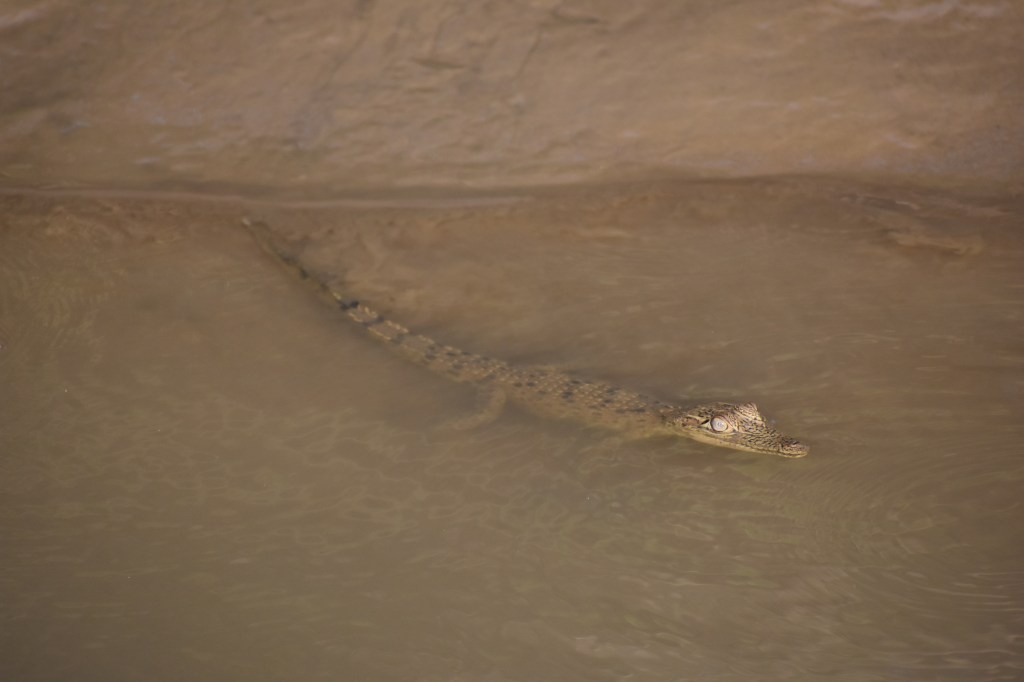
We putter down the river, the famed Bhitarkanika that lends its name to the national park. The water is murky under the hot sun, swirling occasionally as fish disturb the surface. An estuarine crocodile suddenly surfaces, its tail acting as a rudder steering it towards the shore. As our boat draws parallel, the crocodile sinks, a trail of bubbles the only sign that it lurks underwater.
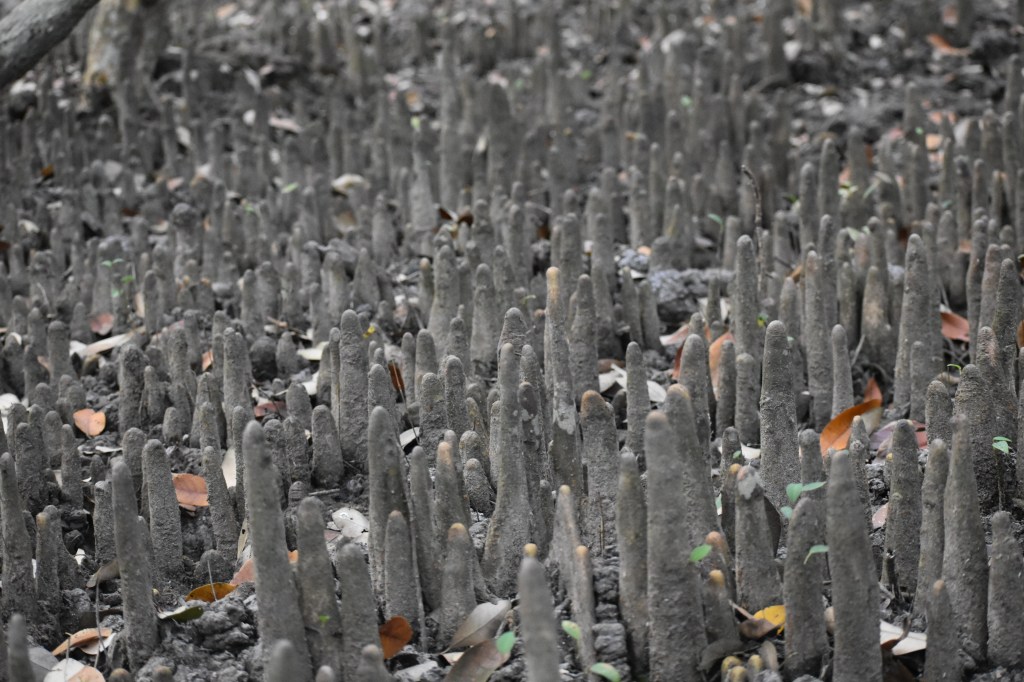
Kingfishers perch on the Sonneratia mangroves (riverine species), watching the river for signs of life. The black-capped kingfisher is endemic here and we spot three of these gorgeous birds decked in their finery. We pass a short stubby mangrove associate species – Acanthus ilicifolius. Suddenly, we pause the boat to admire one of the most endangered mangrove species of the national park – Amoora kukulata – which is blooming with tiny yellowish-white flowers. Our guide tells us that this is an extremely rare sighting. As we drift past the stand of mangroves, I study the prominent peg roots poking out of the moist, clayey soil. These roots are an adaptation for life in a flooded environment. Currently, the tide is low, but it will rise. Already, we can see that it is creeping inshore hungrily. The exposed peg roots will soon be underwater, only their tips poking out to help the mangroves breathe.
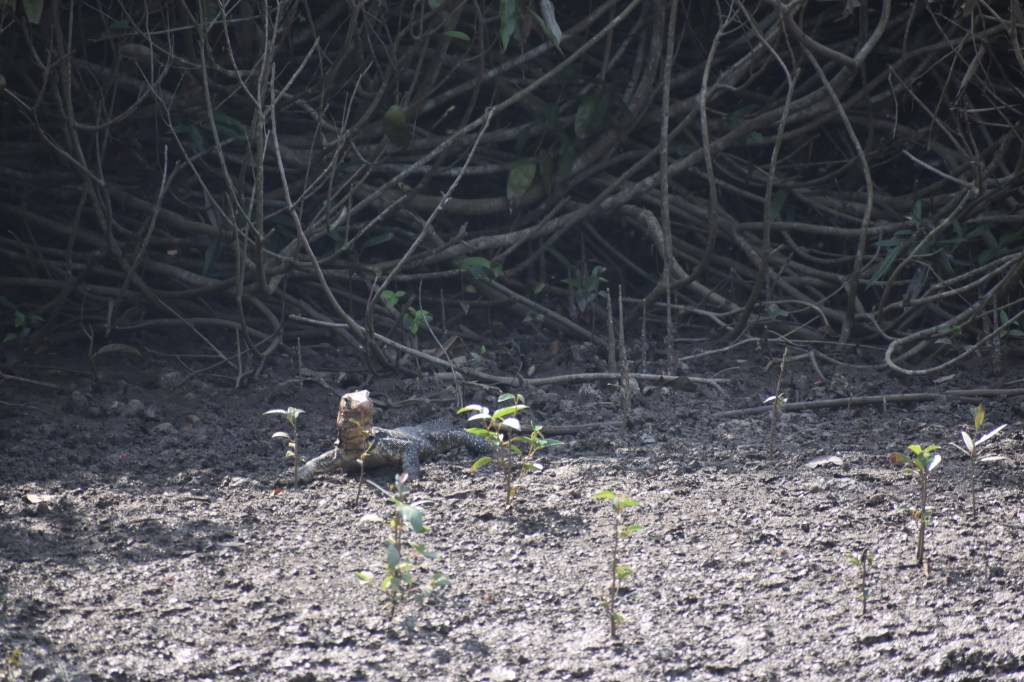
A water monitor lizard sunning itself on the riverbank stares at us unblinking. It looks just like a regular monitor lizard except for small morphological differences – a black band with yellow markings can be seen extending from near the eyes. Fun fact: this is the world’s second heaviest lizard after the Komodo dragon! Out here in Bhitarkanika, this lizard preys on crocodile eggs and young. Seeing it, everyone on the boat oohs and aahs, which rapidly changes to muffled squeals as we spot two tiny chital fawns lying quietly in the tall nalia grass. The mother must have left them there and gone in search of food. Tender shoots protrude from the mudflats during the low tide, only to be swallowed during the high tide. The fawns watch us calmly with big brown eyes. Their calm also tells us that there are no crocodiles around waiting for a mid-morning snack.
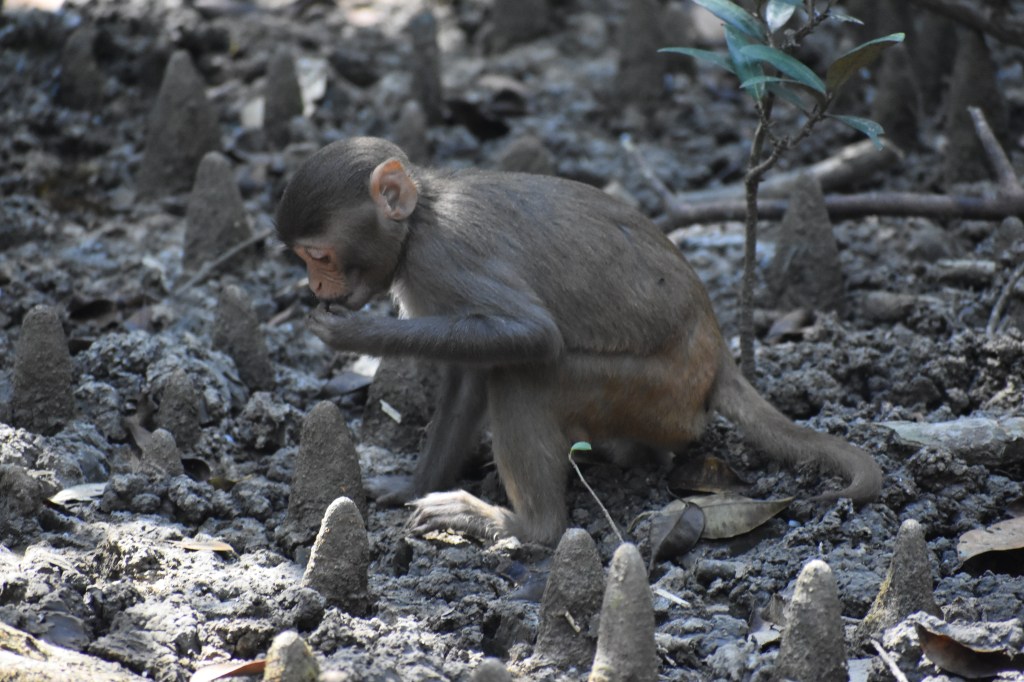
We dock the boat at a floating jetty and climb ashore. Here, the Forest Department has created a mangrove boardwalk, just like the one in Honnavara that I always wanted to visit (but have never managed to see…). Workers are still extracting mud to build the boardwalk, and monkeys squabble over leftover rice from their meal. We wobble over pneumatophores and buttress roots, indicators of a Xylocarpus-Sundari forest. Dr. Hazra tells us that Sundari trees are highly coveted for their wood, which is used in building furniture and devghars (home temples). It merits a mention in ancient Hindu texts as well.
I cannot help but notice the differences between these roots and the ones I see in Myristica swamps. In my study sites, the common adaptive roots are stilt roots and knee roots. Here, in the depths of this mangrove forest, I have already recorded many types of roots: buttress roots, stilt roots, knee roots, peg roots (pneumatophores), and snake roots. The sheer variety is astounding. Even the knee and stilt roots look different in mangroves vs. Myristica swamps; in mangroves, there is no gap below the knee root as seen in Myristica swamps. Perhaps the constant flushing of water in and out with the tide allows for sediment buildup and trapping on the inland side of the roots, filling in the gap. In Myristica swamps, the constant rushing of streamwater has prevented sediment trapping, maintaining the arching gaps beneath each knee root. Or maybe the mangrove soils are thicker, and the roots barely protrude out from the soil, whereas in Myristica swamps, due to a high water table, the soil layer is thin and the roots protrude further. Only research will shed light on this, I suppose…
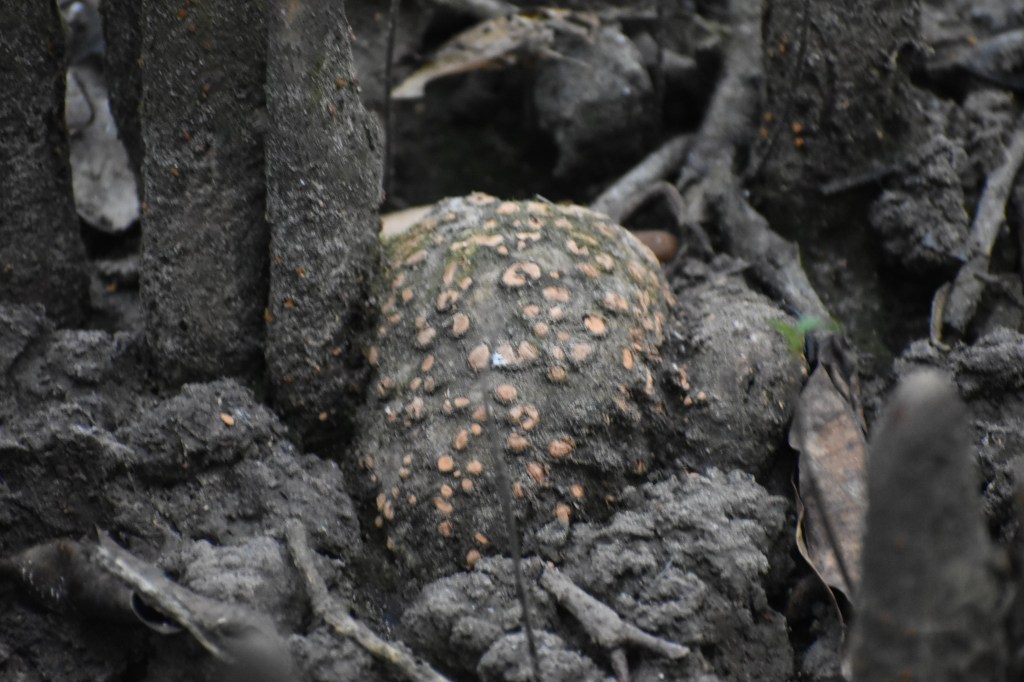
Dr. Hazra also teaches us about the three types of mangroves. True mangroves are (1) only found in mangrove forests and nowhere else, (2) sometimes form pure stands or make up a majority of species in mangrove forests, and (3) have adaptations to life in submerged conditions. Mangrove associate species are always found with true mangroves but lack the characteristics associated with mangroves, i.e. salt removing glands and root adaptations. Finally, back mangroves are found in non-saline soils but are still influenced by salinity to an extent.
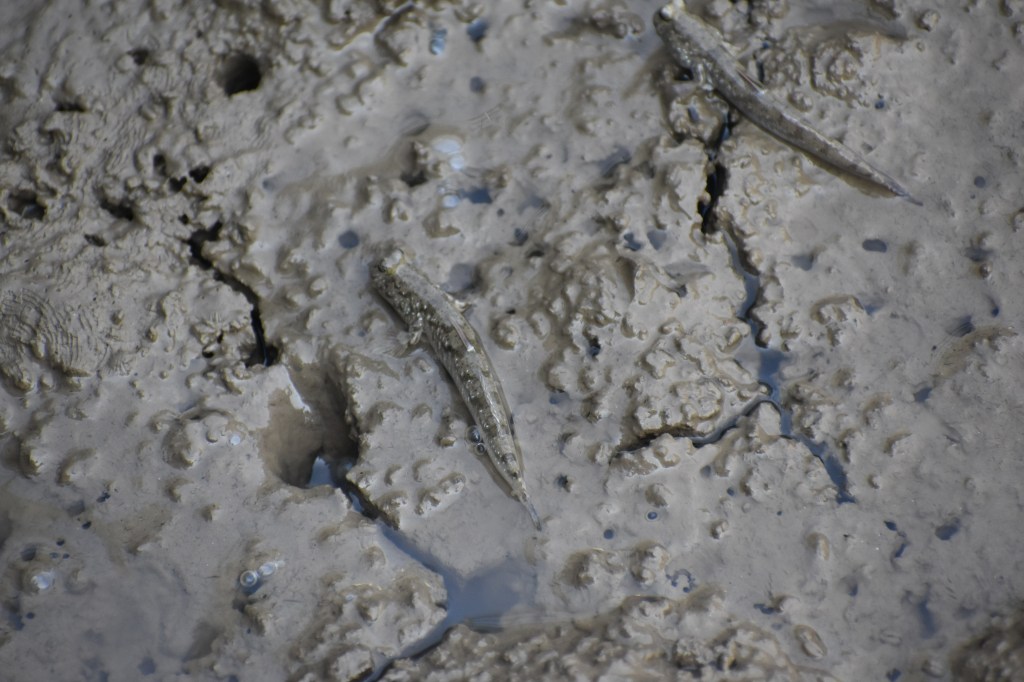
Floating through a sea of mangroves made me appreciate the sheer diversity and tenacity of these forests of land and sea. With constant influxes of seawater and freshwater, mangroves have developed a variety of tools protecting them from the harshness of their surroundings. As we explored the wonders of Bhitarkanika and its wild denizens – plant and animal both – I decided that my heart belongs to swamps, whether freshwater or estuarine.
The crocodiles sink beneath the water’s surface as we putter back down the river. The evening fast approaches and the hunting hour is about to begin.
 On Life and Wildlife