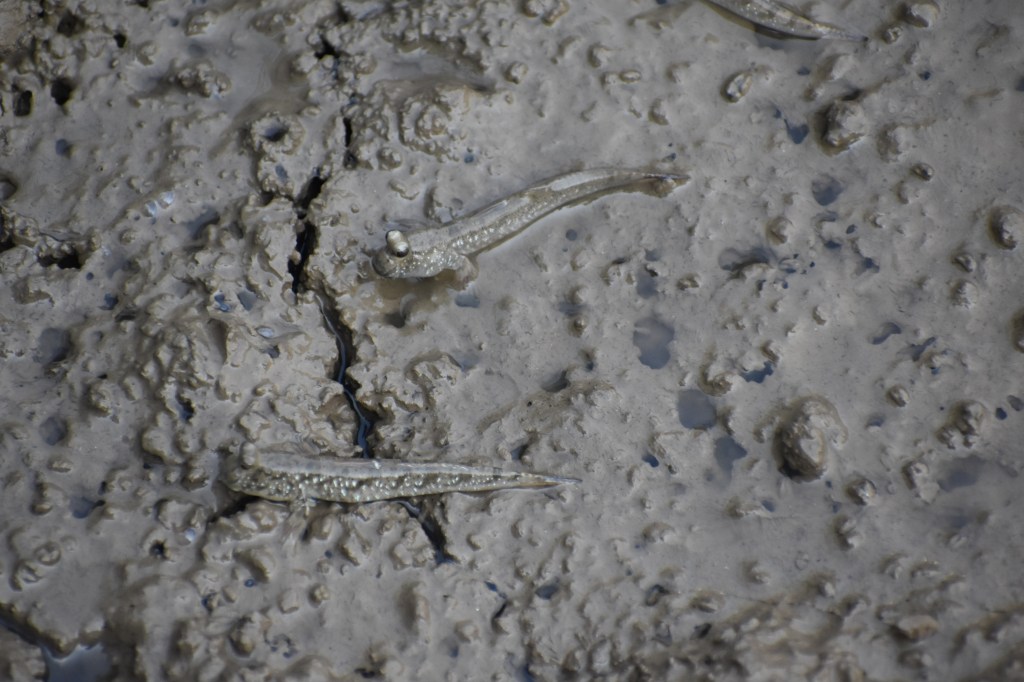
Mudskippers look like an odd mix of tadpoles that are just beginning to grow limbs and fish flopping about on the exposed mudflats. These tiny fish are known as the fish that climb trees. They hop about using tiny jumps and are amphibious in nature, able to survive both on land and in the water. Male mudskippers dig burrows and then hop about around the burrow entrance, hoping to entice a passing female. A suitably-impressed female will follow the male into his burrow and lay rows of eggs, thus spawning a new generation of these strange little creatures. I stare at the mudskippers in utter fascination – I have only ever heard of this fish but this is the first time I am seeing one in person. Their googly eyes make them look like tiny cartoon creatures. A crab scuttles too close to a mudskipper and the fish nearly bends in half trying to wriggle away. Two mudskippers come face to face and one neatly smacks the other with the front half of its body. Harsh is the world of mudflats…
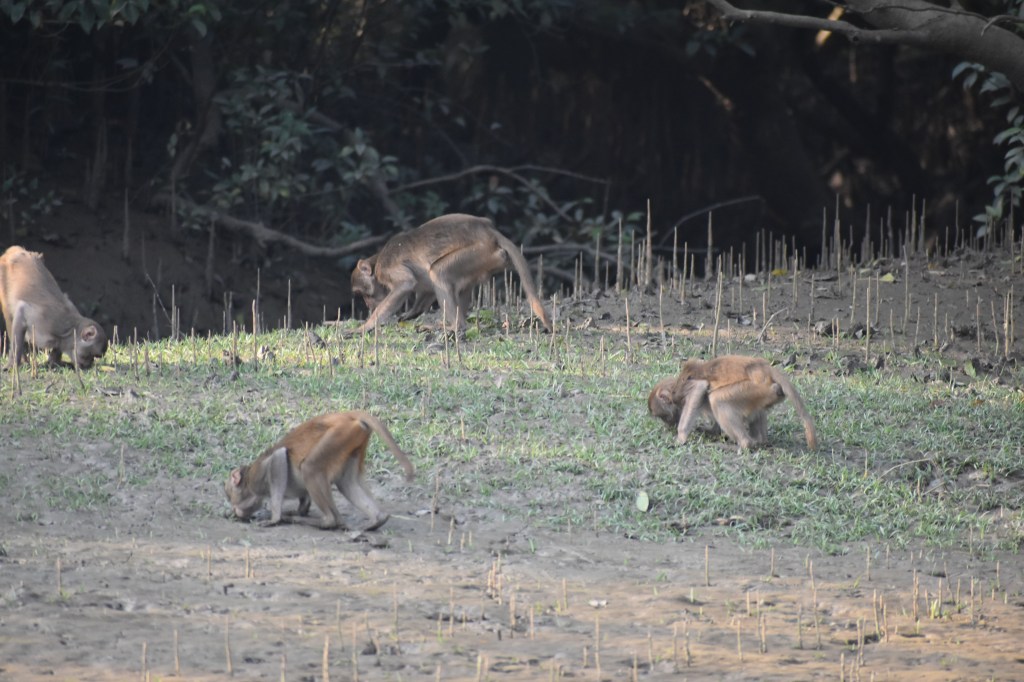
Rhesus macaques are directly putting their mouths to the exposed mudflats to feed. A group of about 20 of these mischievous monkeys performs this behaviour simultaneously, a few of the older troupe members keeping a sharp lookout for crocodiles. The macaques appear to be eating small crabs and insects as well as using their hands to pluck tender blades of grass.
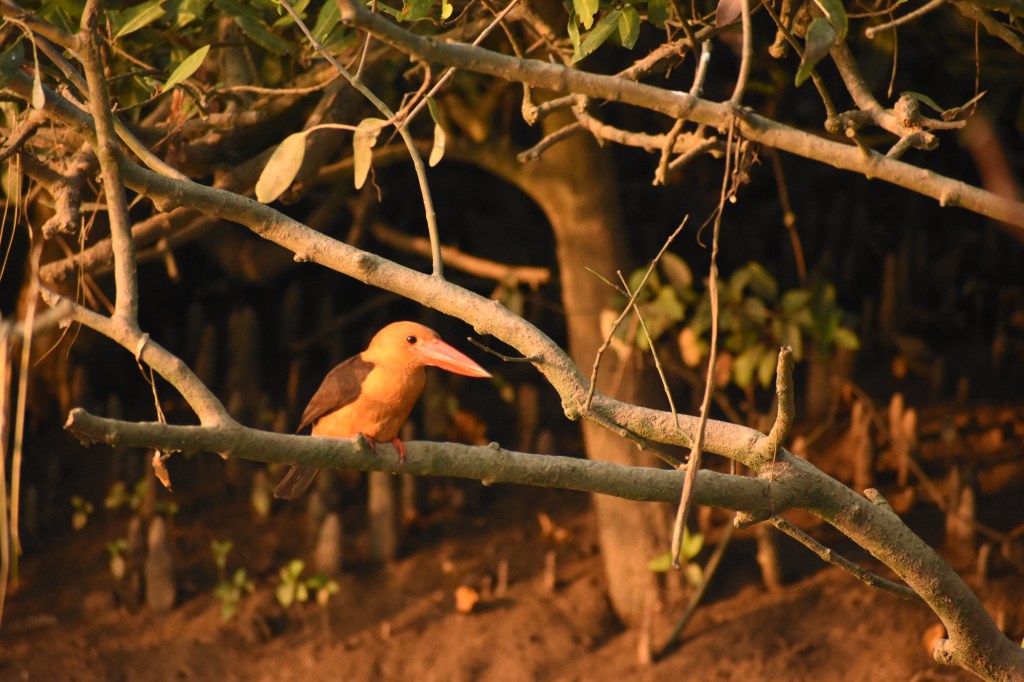
A brown-winged kingfisher perches on an overhanging branch. This is a large kingfisher, far larger than the airy pied kingfishers that swoop and swirl around the boat, hunting insects and fish with reckless abandon. We see a black-headed kingfisher soar by only to land on the next tree. The mangroves, with their shaded branches, offer an excellent vantage point for these colourful hunters to spot their prey. A water monitor lizard stares beadily at our boats, legs splayed wide as it basks in the blazing sunlight.
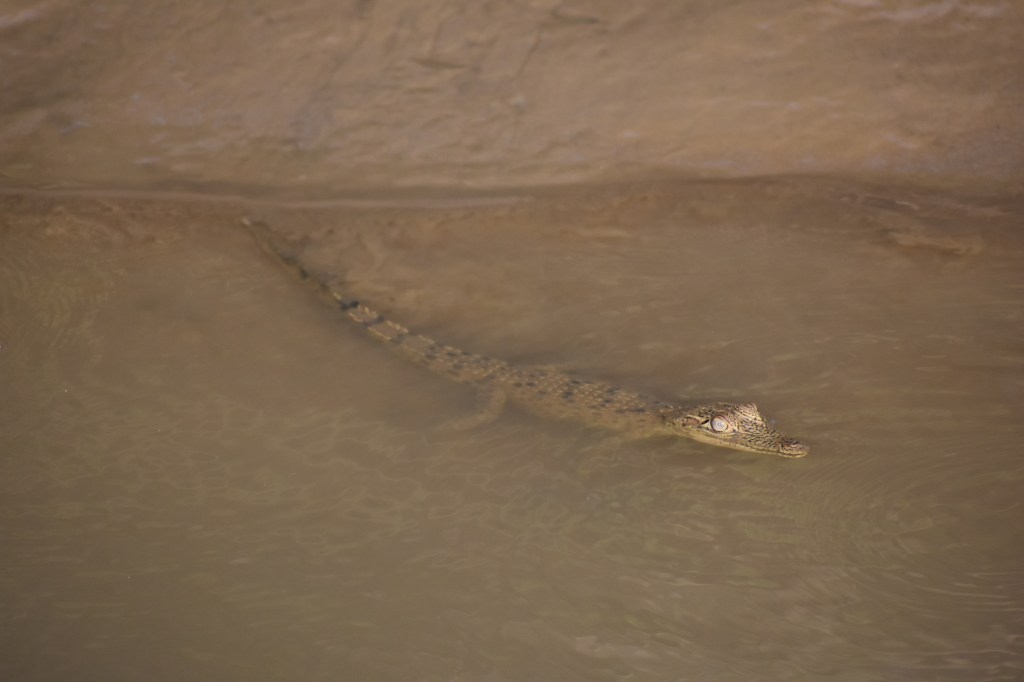
Tiny crocodile hatchlings, barely a foot long, slither into the water as our boat stirs the waters. Our guide tells us that they are part of last August’s brood, not yet a year old. The survival instinct is strong in these little crocs, honed by months of escaping larger crocodiles, monitor lizards, and white-bellied sea eagles. Apparently, even some large fish will snatch up little crocodiles before they can fight back.
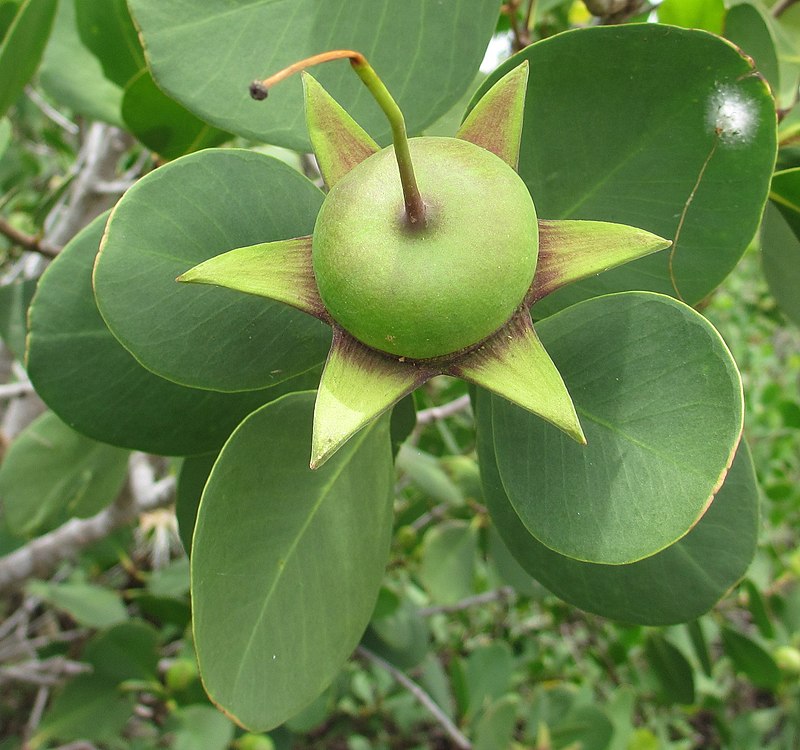
The fruit of Avicennia officinalis and Sonneratia are the preferred food choices of a species of catfish. Catfish, thought not particularly picky about what they eat, tend to be bottom feeders. Does the fruit plop into the waters and sink, allowing these bottom-dwelling fish to feast? Do no other fish compete with the catfish over this tasty treat?
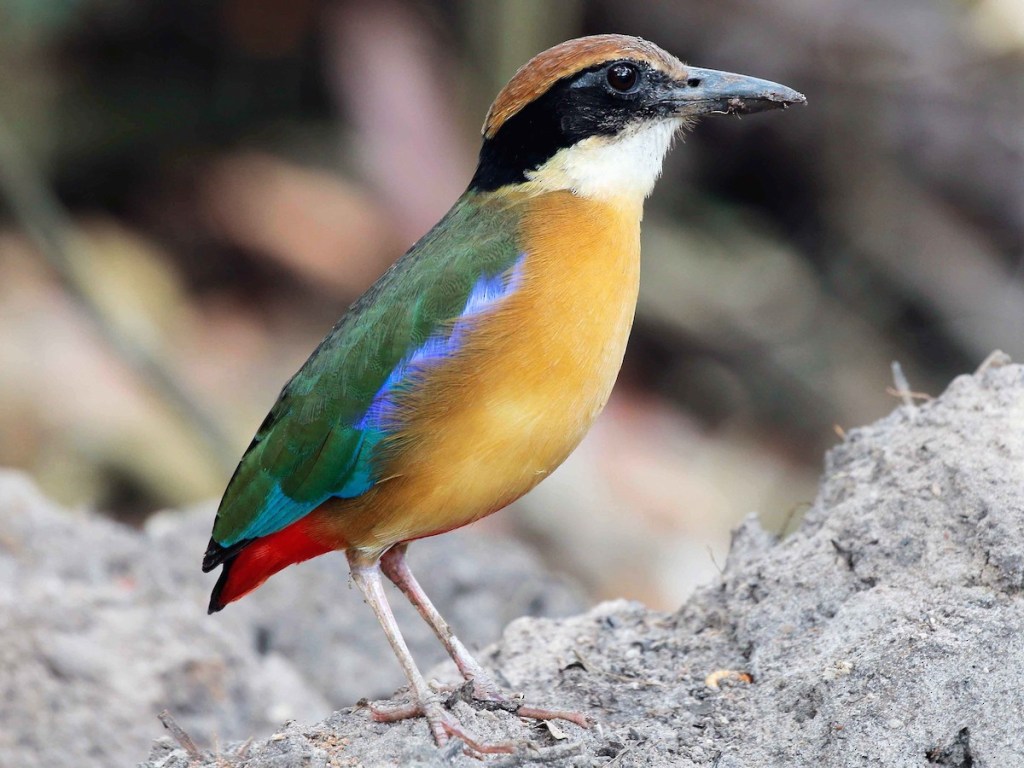
The slightly-weary call of a mangrove pitta captures my attention. The boat engine stalls; the pitta continues its soliloquy. I cannot identify pittas on most days, but this pitta’s voice holds promise. I wonder why it lives only in mangroves. What are its adaptations to this unique ecosystem?

Tiny red fiddler crabs scuttle across the moist soil. Their burrows look like small holes that threaten to collapse in upon themselves whenever the tide washes in. Do crabs in mangroves play a role in seed dispersal like those in Myristica swamps do?
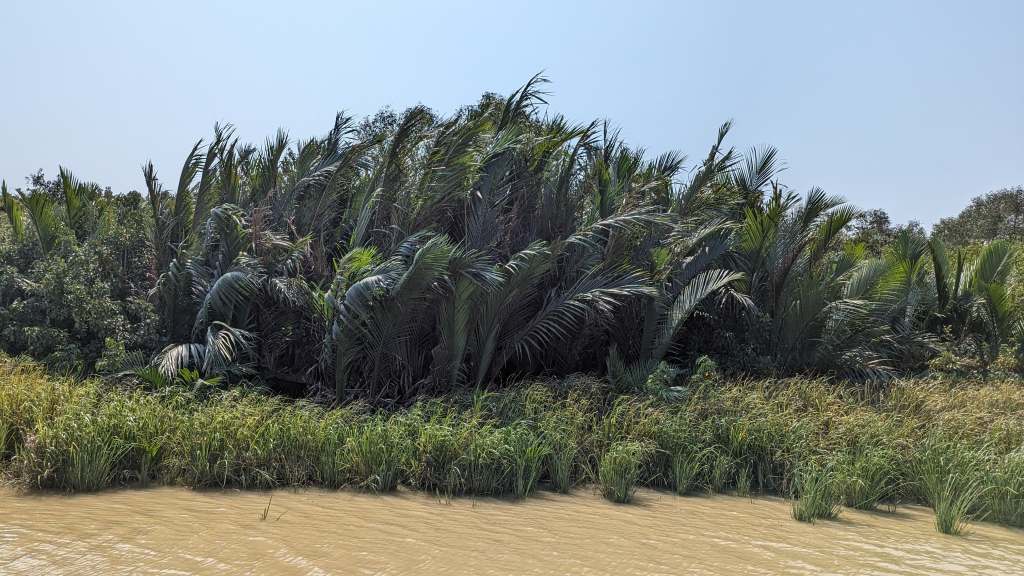
We see a stand of Nipa fruticans, one of the oldest (evolutionarily) existing mangrove species dating back to well before India joined Eurasia and the Himalaya was born. This mangrove looks more like a towering fern than a true mangrove, a far cry away from Rhizophora with its stilt roots…
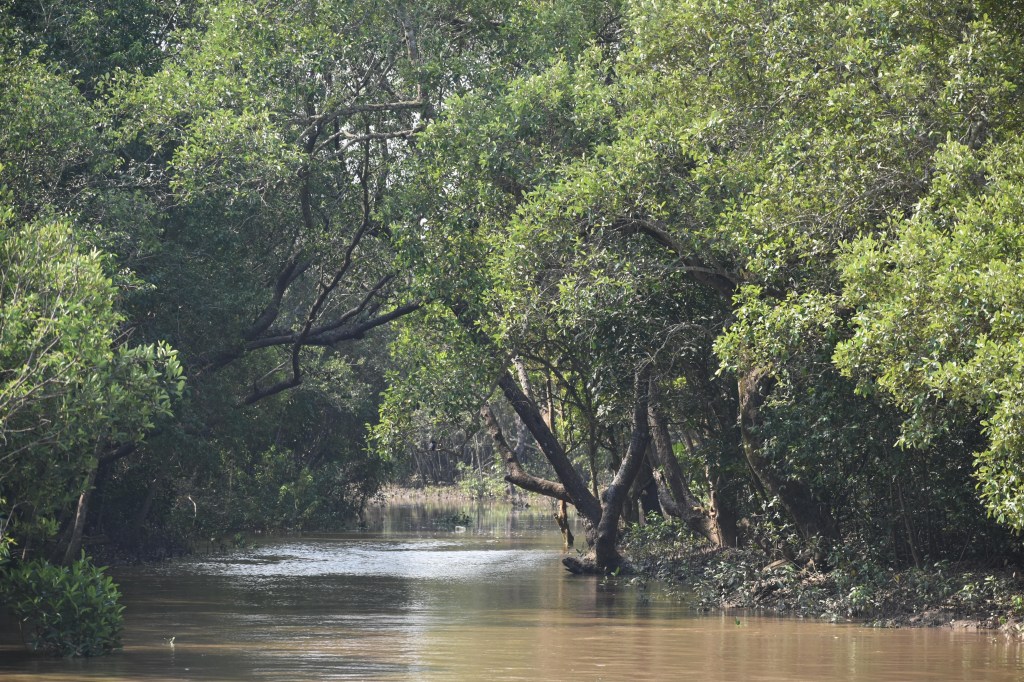
Bhitarkanika, like other mangrove forests, is a maze of rivulets. Freshwater inlets wind in between propagules and pneumatophores, flushing the root system. Chital hoofprints ruin the smooth mud and I keep a sharp lookout for the pugmarks of the fishing cat, my latest obsession. Otter claw marks dot the mud. A hodgepodge of bird footprints makes my head spin. The fiddler crabs dance around the chaos, popping into their burrows as we squat to examine the pugmarks more closely.
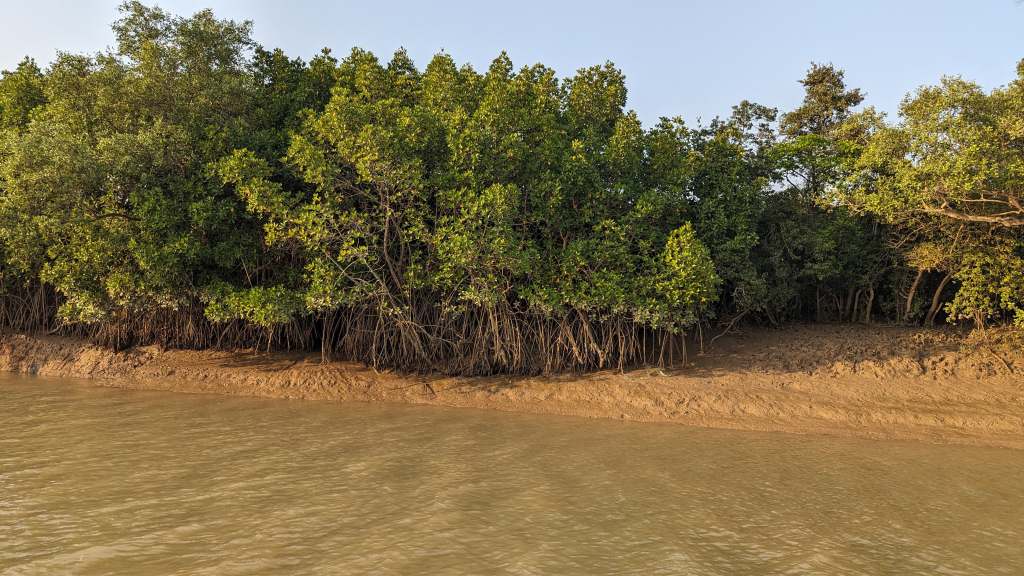
It is not the water salinity alone, but soil salinity that governs the species zonation of mangroves. From Avicennia to Sundari, mangroves form a protective barrier along topography. Naturally, the higher ground coincides with less salinity, and Sundari trees flourish here. Out on the frontlines, you may chance upon Avicennia, with its peg roots and hardy bark. Mangrove leaves weep salt, an adaptation to life in a salty clime. But there are mangroves that have barely any interaction with seawater, like those found in the Mahanadi rivulets of Chilika or in a small patch in Kolkata. Sonneratia is one such species. When the salinity is high – around 20 – Rhizophora dominates, standing high on stilt roots.
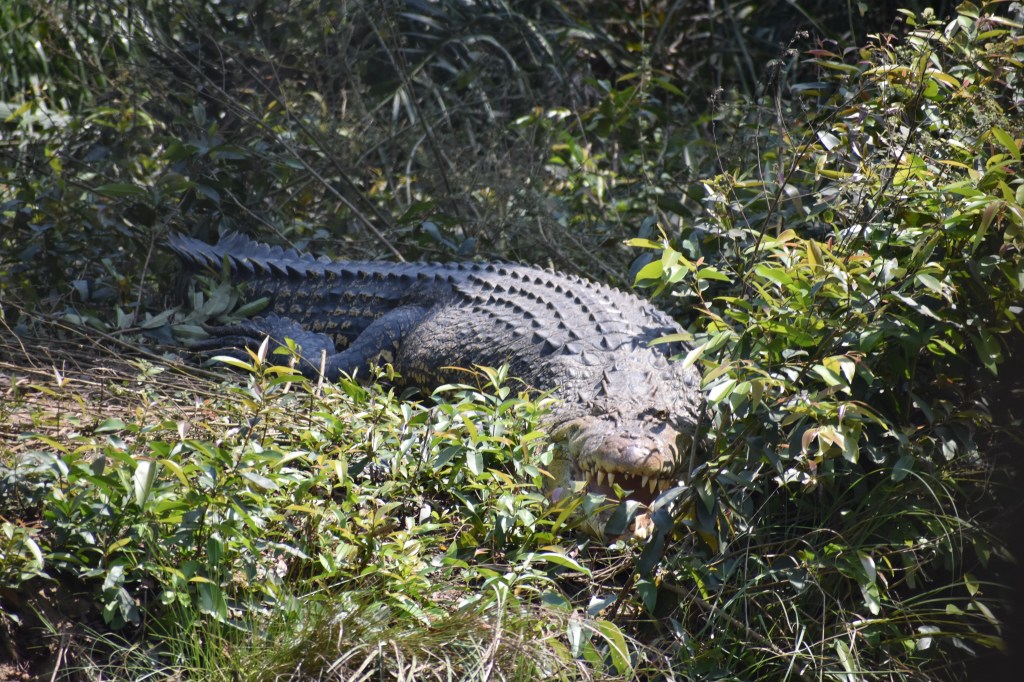
There is an enormous splash as a fully-grown crocodile lunges out of the river. Its powerful jaws lock around a lapwing pecking too close to the shore. Quicker than the blink of an eye, the crocodile slides back into the water, taking the unfortunate bird with it. It all happens so fast; the bird’s mate screeches plaintively, its echoing calls fading into the distance as our boat putters away towards the sunset.
 On Life and Wildlife
Bhitarkanika’s status as a wildlife sanctuary and its inclusion in the Ramsar Convention list of Wetlands of International Importance highlight its ecological significance. Strict regulations and conservation measures have been implemented to protect the delicate mangrove ecosystem from deforestation, pollution, and human encroachment. These efforts have led to the recovery and preservation of several endangered species and their habitats.
https://www.indianetzone.com/77/bhitarkanika_mangrove_forest.htm
LikeLike