The crik-crik-crik of the Malabar gliding frog fills the still air of the Forestry College Horticulture Garden. We skirt around the pond in our pyjamas, the dogs sniffing busily at our heels, taking care to not startle any snake that might be out on the hunt. Up ahead is a palm with lovely arching fronds. The frog’s call is coming from there, as piercing and clear as the notes of a reed flute.
Dhananjay carefully tugs at the nearest frond and suddenly, I see them! Two Malabar gliding frogs, their perfect beady black eyes nervously eyeing us. We take care to not disturb the frond too much. It wouldn’t do for them to hop off or injure themselves trying to get away from us.
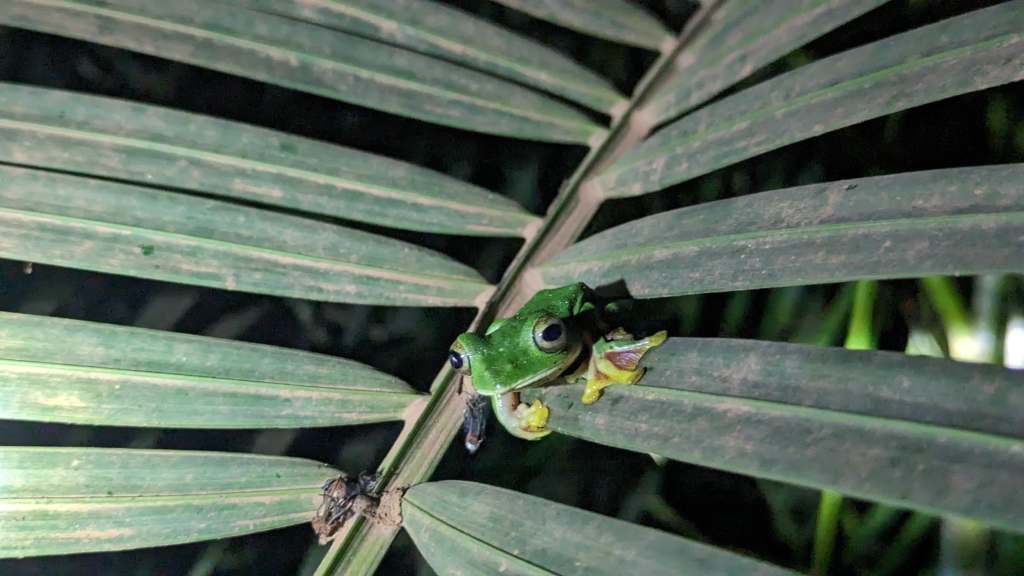
I take the chance to carefully observe these rare frogs. Endemic to the Western Ghats of India, gliding frogs are named for their ability to break their fall by stretching the webbing between their toes when leaping from the treetops. Much like the flying squirrel, this little creature has adapted to a unique niche for a frog – life in the trees! I notice the webbing between the nearest frog’s toes now, bright reddish-orange in contrast to the frog’s vivid moss-green body. These are males, Dhananjay informs us, distinguishable from females by their smaller body size. The green is granulated, almost like the surface of lady’s finger (bhindi) and the belly appears yellowish in the golden light of our headlamps.

At this point, we realise there are not just the two frogs on the frond we are holding, but two more on the next frond. Their lithe bodies shift slightly for balance as we observe the new boys on the block. More males, all crik-crik-criking like a slightly out-of-tune orchestra, their green bodies providing the perfect camouflage against the palm leaves.
The pond itself is an ecosystem worth exploring on a day without much fieldwork. Located squarely in the Horticulture Garden, this man-made ecosystem is filled with hidden treasures. When busy looking for the Malabar gliding frogs, I paused to glance into the pond (partly to ensure I wasn’t about to plop inside it!) and jumped back, startled, at the sight of a massive Indian bullfrog glaring up at me.
In all truth, the poor frog wasn’t glaring; it’s eyes were simply reacting to the sudden flash of my headlamp. I knelt at the edge of the pond and peered closely at the frog. With its enormous size, it looked a bit uncomfortable on the lily pad it was perched upon, but it was well equipped to stay afloat in the water. The frog was a male, and Dhananjay pointed out that we could identify the sexes based on the snout-vent length (SVL length). Female bullfrogs tend to be larger; the species has distinct sexual dimorphism.
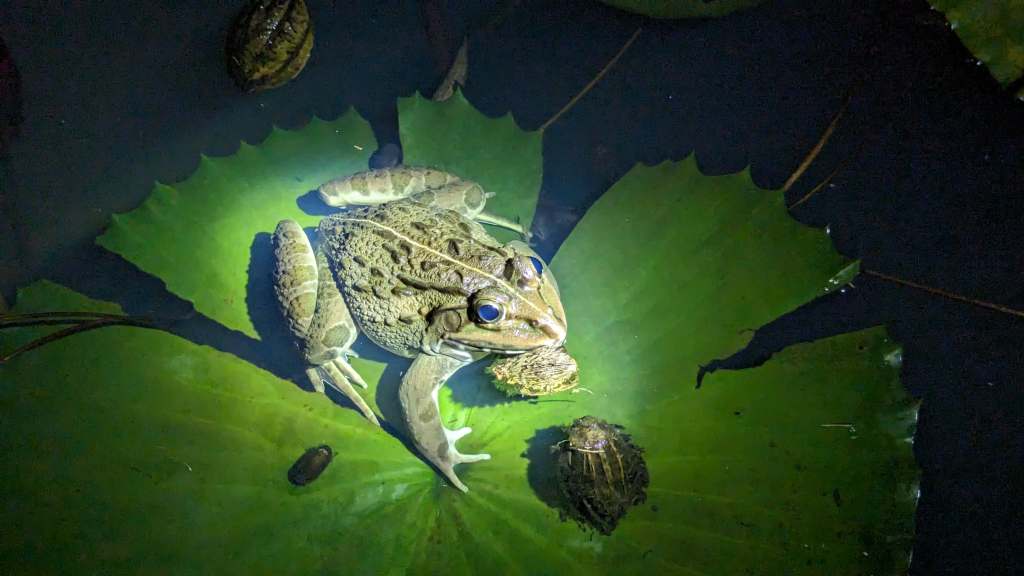
The lotuses were in full bloom despite the nighttime hour, casting a pale pink glow in the torchlight. Their broad flat leaves provided the perfect surface for frogs to sit, waiting for insects to fly by. We noticed skittering frogs and bullfrogs, coexisting peacefully, each upon its own leaf occupying its own fast food lane. I waited in hopes of seeing one catch a passing insect, but to no avail; the frogs sat still, almost as though they knew I was watching and were determined to put on a poor show.
The trail to Darbejaddi is always a workout, especially if I set out on it after a long break from the field. We leave the bike in a small clearing above the stream and set off on a downhill trek, peering around every corner for the deceptively-sluggish gaur. Leopards are common here, but we are far more likely to be seen by these big cats than to ever see one. The forests are dense here, providing ample habitat and hiding spots that our eyes and ears cannot sense.
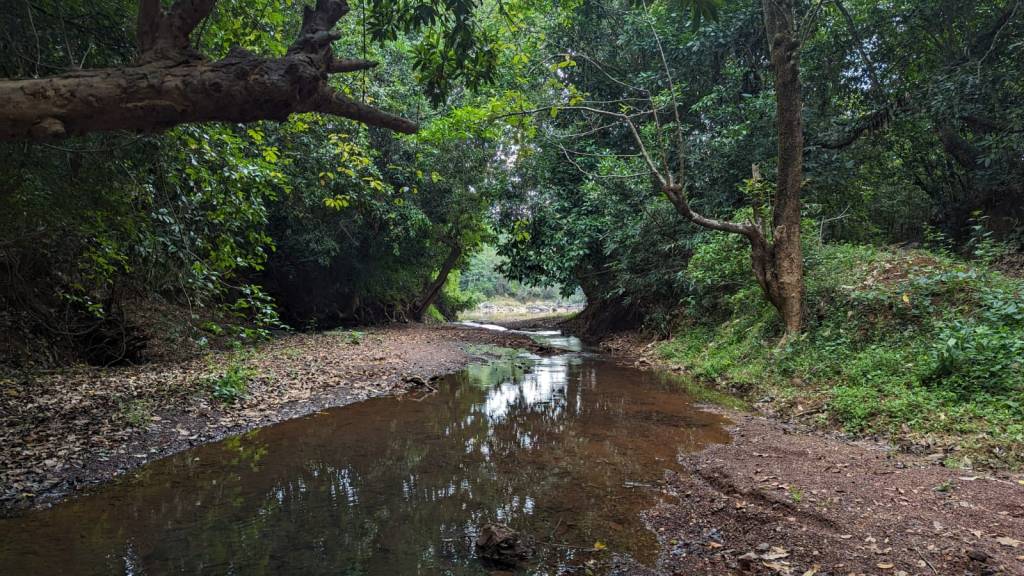
We finally make it down to the stream, and given that we still have a few kilometres to trek until the swamp, I suggest we stop and check for birds, snakes, and frogs. The stream is thin and fast flowing on this last week of May, perfect for wading and spotting the critters hiding in the streambed or by the banks. Come monsoon, crossing the stream will require a sturdy rope and the will to paddle across waist-deep water. But for today, it is ideal for frogging.
I crouch by the water’s edge, peering at the clear gurgling stream. Fish sometimes zip through these water, tiny rasbora (a genus within the Cyprinidae) darting through, disturbing the crabs and crayfish that paddle along the streambed. But what catches my eye is a sudden leaping movement. A dark blob hops awkwardly to the far bank of the stream (a mere 30 cm away from me).
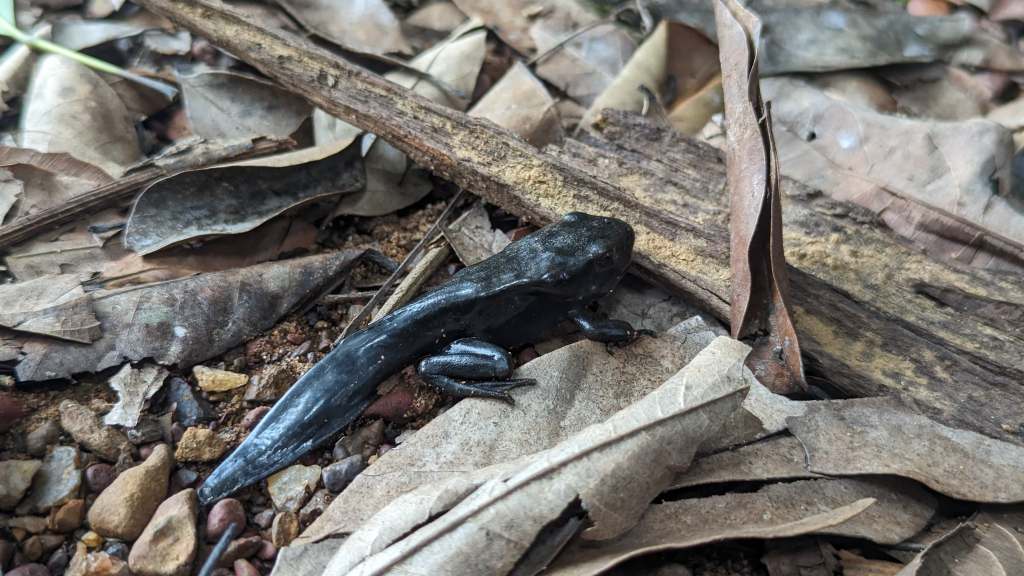
The strangest sight meets my eye. A half-formed frog – not quite shed the tail of tadpole-hood and not yet grown into the legs that will help it survive as an adult frog – hops awkwardly up the bank. It is a dark glossy brownish-black with small yellow speckles.
“Look!” I call to Dincy, who has also spotted the strange creature. No, creatures, because as I stare in amazement, the entire hillside appears to be shifting, writhing, hopping, as thousands of tadpoles/frogs hop frantically across the stream. On both sides of the stream, we watch the ground shift as the tadpoles swarm. It is a splendid sight, awe inspiring and absolutely unexpected, a gift from Mother Nature.
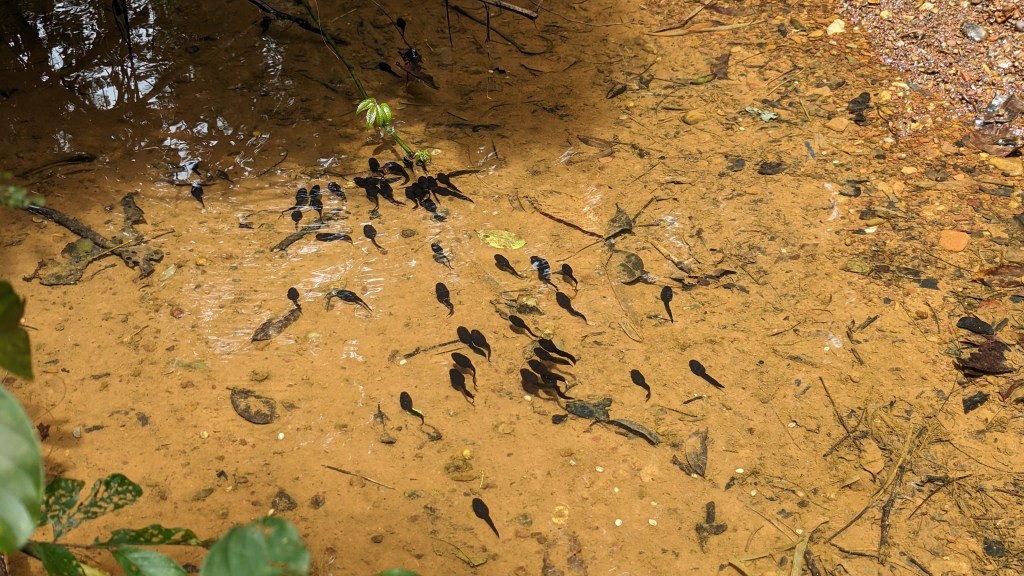
We watch the froglets hop their way to the shore and I remember seeing shoals of tadpoles – fat, black tadpoles – swimming around this very stream in September. Later, I learn that these are bicolour frogs or Malabar frogs (Clinotarsus curtipes), endemic to the Western Ghats. These unique frogs spend their tadpole stage moving in large swarms in slow-moving forested streams like this one in the forests near Darbejaddi. A fun fact: bicolour frogs can remain in the tadpole stage for years until habitat and climatic conditions are ideal for them to make the transformation into adult stage. I saw vast swarms of bicolour frog tadpoles in the shallows of the Aghanashini River in May 2023 and then again at the end of September 2023. Now, at the end of May 2024, the conditions are finally right, the monsoon is on its way, and the landscape is alive with bicolour frogs on the road to adulthood.
 On Life and Wildlife