I have always loved writing, but sitting down to actually write The Dark Forest was a surprisingly daunting task. Not the researching and actual writing part, but the knowledge that this is the first actual guide to biodiversity of an ecosystem that I hold very dear to my heart.
Many researchers have studied the biodiversity of swamps. Drs. Aravind, Gururaja, and Preethi Gururaja studied amphibians in the Myristica swamps of Uttara Kannada, Drs. Joyce Jose and Roby assessed biodiversity of swamps in Kerala, and stalwarts like Dr. M.D. Subash Chandran and Dr. R. Vasudeva have made pioneering assessments of the rare swamp trees that are found in Kathalekan and other swamps of Uttara Kannada. Others, like Dr. Balu Hegde and Yogesh Bhat have been working hard in this landscape to delineate conservation reserves, protect corridors and swampy habitats, and understand the hydrology of swamps for decades. While reading their work, it struck me that although I have been immersed in the world of swamps since 2021, I am still a novice, still starting out on this larger journey as a researcher, as someone who makes valuable contributions to the field of knowledge. While wandering through swamps, I pick up tiny details that strike me as fascinating, but are probably well-known facts of life in these hidden forests to the local people who live in this landscape and to the researchers who have come before me. It’s a humbling experience.

Writing this book started from an idea that, as an outsider to Uttara Kannada, I enter each day in the field with fresh eyes and no prior judgements. Thus, the stories of the land stick with me and shape my way of thinking about the swamps in this landscape. The people I meet shape my knowledge and my experiences and the way I go about my work, which is something that a person from the landscape will rarely receive. Someone from Uttara Kannada will not need to take a local farmer along when finding new swamps; he or she will have knowledge of the landscape and likely have contacts that tell them personally where to find swamps. But as an outsider, I have to find contacts, build relationships, and find my place in this complex socio-ecological area.
My first few forays into Myristica swamps were blurs of muted colours, sonorous birdsong, croaking frogs, and tripping liberally over knobbly knee roots. I used to watch my every step, worried of disturbing a hump-nosed pit viper or grabbing a plant that would leave me with a resultant itch. Pandanus, a common species found in swamps, has sharp thorns along its leaves (protection from herbivory), and I was the proud recipient of more than a dozen scratches on my first day in a swamp, a statistic that has only slightly reduced with time. I remember wondering what I could contribute towards the scientific understanding of these majestic swamp forests and feeling insignificant standing at the foot of those towering trees.
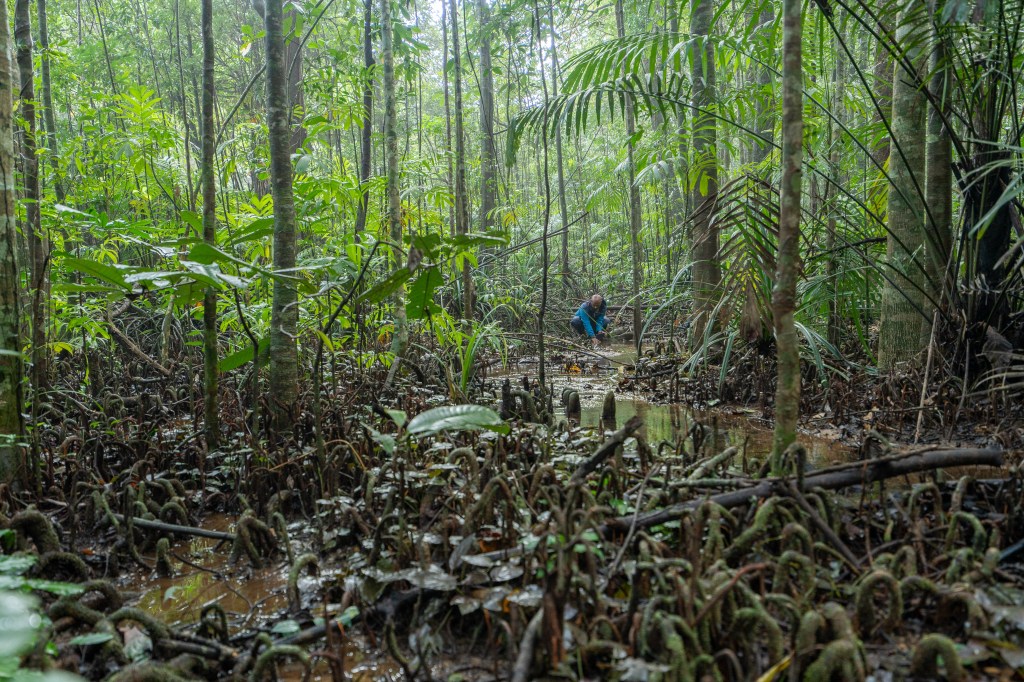
All of the stories from the people who I have met, the insights of scientists long-immersed in this landscape, and the students who have accompanied me to the field – along with my own experiences and learnings – have gone into the creation of this book. The love of Myristica swamps has served as a fuel for writing even when I had imposter syndrome and a heavy dose of “more important work” to finish, and the enthusiasm and dedication of Meera, the illustrator on this project, kept the project moving forward towards completion.
I hope you enjoy The Dark Forest and the hidden world of Myristica swamps that it offers. Do reach out if you want to know more about these endangered ecosystems and the myriad species that are found in their misty depths!
 On Life and Wildlife