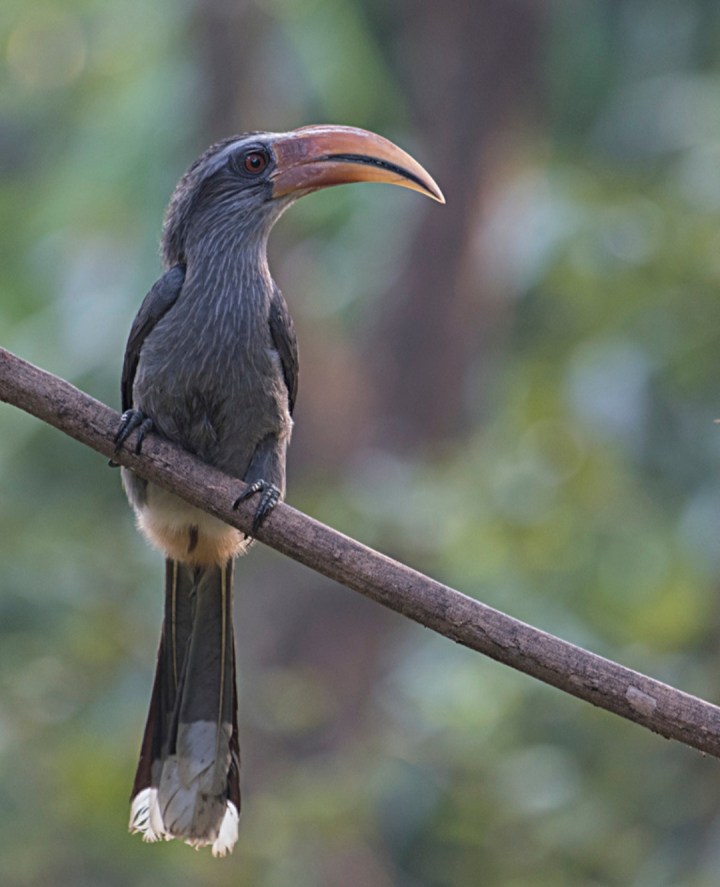
Mornings at the field station are a rare delight now that I have become familiar with the vibrant bird life of Siddapura. Early in the morning, a familiar cackling call stirs me from sleep. A hornbill – probably a Malabar grey hornbill – and by the sound of it, it’s right by my room. I sleepily trudge out onto the little terrace behind the room where I work during the day and peer into the misty plantation. Sure enough, a majestic hornbill perches on teh arecanut tree nearest to me. With a yellow beak, gently curved, and large grey body, this can only be a male. This is the smallest hornbill species in the Western Ghats, and one that serenades the dense forests where I work.
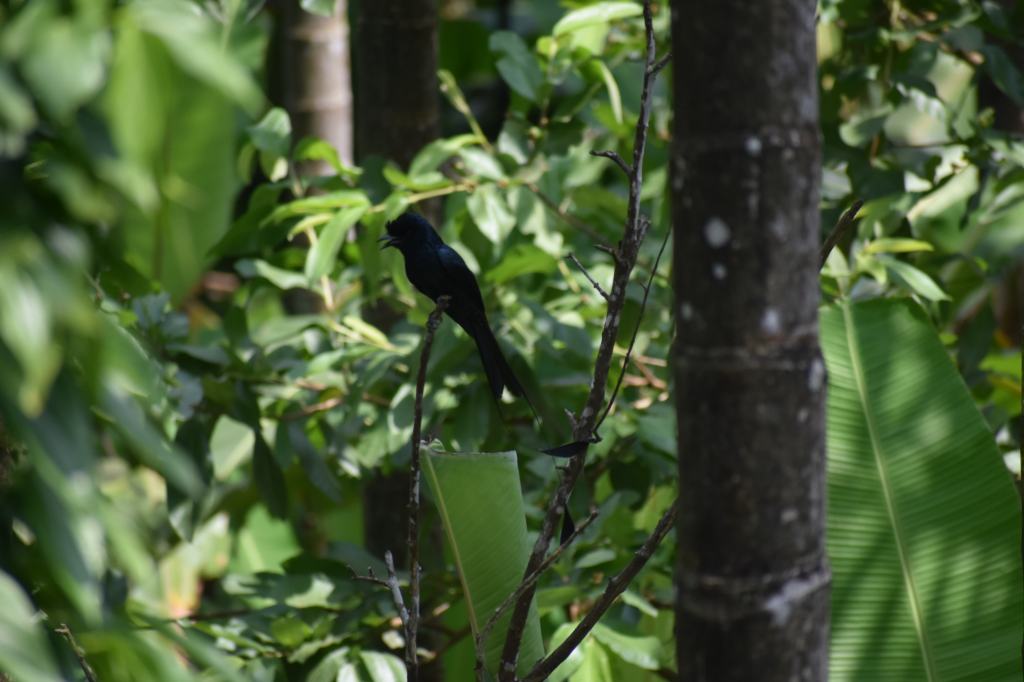
I am suddenly distracted by a smaller yet rowdier visitor – a racket-tailed drongo. Drongos are excellent mimics, and this one seems to have it out for the hornbill. It perches on a low branch of a banana tree (the understory of most arecanut plantations in this landscape is comprised of banana, black pepper, cardamom, and vanilla) and begins to make a hoarse cackling sound. Both the hornbill and I glare at this perky visitor; the drongo is mimicking the call of a female Malabar grey hornbill, an act that is clearly not endearing it to the male perched nearby. The hornbill bobs its head a few times and the drongo increases the volume of its mimicry. Conceding defeat, the hornbill spreads its white-tipped wings and sails off to a different tree. The drongo begins to preen its shiny black feathers, cheerfully unrepentent.
Two greater flameback woodpeckers dart by, latching onto a young arecanut tree near my vantage point. They drill briskly at the bark, once, twice, thrice, and then fly off in silent agreement. Their drilling frightens up a cloud of Malabar parakeets, which squawk in dismay at the intrusion in their tree. These parakeets are a beautiful pale bluish-grey and sleekly built. I wish I had brought out my camera with me, but it is safely in the room. If I go and fetch it, the birds may vanish.
A few mynas replace the woodpeckers on the tree and tap around to see if any insects have been revealed by the woodpeckers’ activity. The racket-tailed drongo, finally tired of preening, sails past them, perching high in another areca tree. It mews plaintively at the mynas, who ignore it. Mynas are equal to a drongo when it comes to making a ruckus.

I sit down in a chair and wait for the next visitor to appear. Sure enough, after a few moments, another hornbill appears, this one flying over the paddy field to land in the areca. Hornbills prefer wet habitats, and arecanut grows well in these moist rainforests and river valleys bordering evergreen forests. Farmers often complain about hornbills raiding the areca fruit during the harvesting season; I have often seen clouds of hornbills fluttering around arecanut trees during the harvesting season as angry farmers use long poles to try and dissuade the feasting birds. Voracious feeders, these frugivorous (fruit-loving) birds are also found feeding on Myristica trees during the fruiting season, a time when they leave crops alone and focus on forest trees.
And suddenly, the peace and quiet (and birdsong) is shattered by a raucous grunting. A troupe of bonnet macaques, red-faced like sweaty old men who have drank too much, appear, slinking over the fence and under the gate into the arecanut plantation. The leader, a large-bodied male with a nicked tail grunts a few times, scaring the farm cat, and the rest of the troupe fans out for a tasty snack. I glimpse a few babies in the troupe, their little tails sticking straight up in excitement. One half-grown subadult scales an arecanut tree and shimmies back down with a tasty fruit in his paw. The other babies make snatches at the fruit but he gobbles it up and leaves no crumbs. Soon, the troupe is spread out among the areca trees, picking and choosing the best of the crop to eat at their leisure. The cat reappears and mews half-heartedly, but the monkeys are here to stay, at least until the farm hands arrive and shoo them away.
I settle back down at my table to continue my work, camera beside me. The plantation will be relatively calm until the evening, when the next set of feathered guests arrive to steal the spotlight.
 On Life and Wildlife