Chalky dust blows everywhere, sticking to the broad-leaved deciduous trees and coating my tongue like a fine layer of powder. The air is steamy and the odour of wet tar scrapes my nostrils even as the grinding roar of the steam roller (or caterpillar, as we like to call it) fades around the bend. Loose gravel and larger stones litter the once-smooth road and the ghostly trees bob slightly as the wind picks up. The smell of tar intensifies, masking the scent of the wild ginger growing by the side of the road.
We park the bike off the road, well into the shrubbery to avoid it getting flattened by the overzealous steam roller. My hair is already getting coated in whitish chalky dust; it would seem that the dust has not yet settled despite the roller having moved a bit downhill. We peer over the edge of the road, down into the trees. There it is. A small red shrine beams up at us like a beacon amidst the dust. Venkateshteertha.

Venkateshteertha was my second sacred swamp in the Uttara Kannada landscape. Precariously tucked into the side of the Sirsi-Kumta highway, this Myristica swamp is fringed to the north by a road and to the east and south by arecanut plantations. Only its western edge remains forested, a buffer against the heavy landscape modification that defines this region.
We met the arecanut farmer who owned the plantations by the swamp while crashing through the stream trying to find knee roots. While the temple was the obvious signpost for the swamp, the trees were harder to find. A Malabar giant squirrel watched our progress with beady inquisitive eyes. The farmer was waiting for us at the end of the stream, arms crossed.
“Looking for something?” he inquired, not quite friendly not not unfriendly either.
“Er, we’re looking for the Myristica swamp,” my co-researcher said. “Knee roots, specifically.”
The farmer looked unsurprised. “Those roots are over this way,” he said, turning and marching through rows of areca trees towards a small hillock. We hiked up and turned back towards the road. There, directly in front of us, was a dense, dark clump of trees. I spotted the grizzled bark of the Gymnacranthera canarica trees before the knee roots poking out of the sluggish water spread around them.

The farmer, however, is pointing at a semicircle of four rough hewn rocks, each about a foot in height, on a flat stone slab. “Don’t step there with your shoes on,” he warned. “We worship here.”
I was intrigued. “Which gods are the stones representing, Uncle?” I inquired.
He pointed at them. “Chowdamma, Jatka, Beerlu, Bhootappa. Our local gods.”
Chowdamma is the water goddess, worshipped in multiple swamps in the landscape. Jatka guards territory and is mostly associated with farms. Beerlu is the village guardian deity. And Bhootappa is a forest demon associated with dark, dense forest patches. The farmer tells us briefly about his worship here.
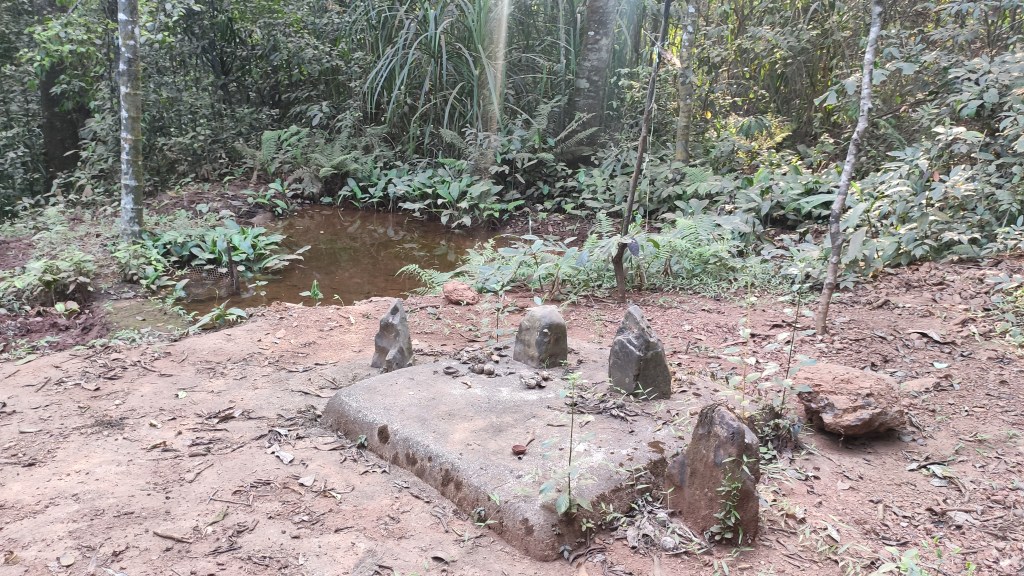
“The villagers come to Venkateshteertha each year at Diwali to pray at the Venkatesh shrine that you would have passed on you way here,” he says, referring to the red shrine near the road. “But only my family and I worship here. These forest deities are looked after by me and three times a year my entire family gathers here to do a puja. But we don’t let others from the village join us.”
Prayer and worship in this region are highly managed, with certain families tending to local deities and presiding over their worship. Others in the village are only permitted to enter the sacred grove during major festivals but cannot perform private puja there. A similar case is seen at Chaare Hulidevarakanu, where the local Brahmin families worship at the tiger god’s shrine but the rest of the village is not permitted to set foot in the grove. Neither, for that matter, are outsides, but the priest made an exception for our research team.
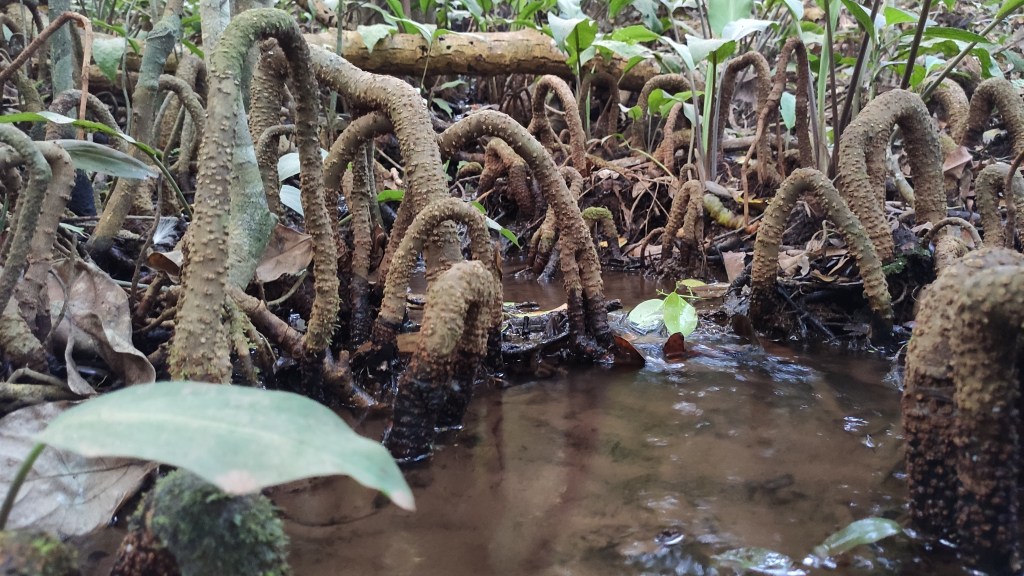
At Venkateshteertha, the swamp is directly threatened by the road passing above it. During the monsoon, rains wash chemicals and pollutants into the once-pristine water, contaminating it and leading to trickle-back effects such as impacts on aquatic fauna, polluting the freshwater supply that feeds the farmer’s arecanut plantation, and impacting the rare flora that are found in the swamp such as G. canarica. Additionally, dust and chemicals from the road construction have added a lot of pollutants to the water, and as I measure the quality of the standing water near the shrine, I wonder how much worse the quality will be when there isn’t a constant washout of pollutants due to the monsoon.
The farmer also talks about the wilder side of the swamp. “We see animals here often. Gaur, wild pigs, langurs, bonnet macaques, giant squirrels, hornbills, snakes, they all show up to drink water here. Plus, the Aghanashini River is right behind my property, so they naturally will live in high densities around the river, right?” When we ask him about lion-tailed macaques, he shakes his head. “Never seen one. Try near the Sharavathi; I have heard about them there.”

We leave Venkateshteertha with a sense of urgency. Understanding the threats to swamps has never seemed more important than in the case of this tiny ancient forest at the edge of the road, awash with contaminants and susceptible to extinction.
 On Life and Wildlife
The country has so much and we never get to hear what the natives feel and live by. What a treasure in search of a swamp.
LikeLike